


A Word In Edgewise: Johannes Vermeer 1632-1675 … and Today
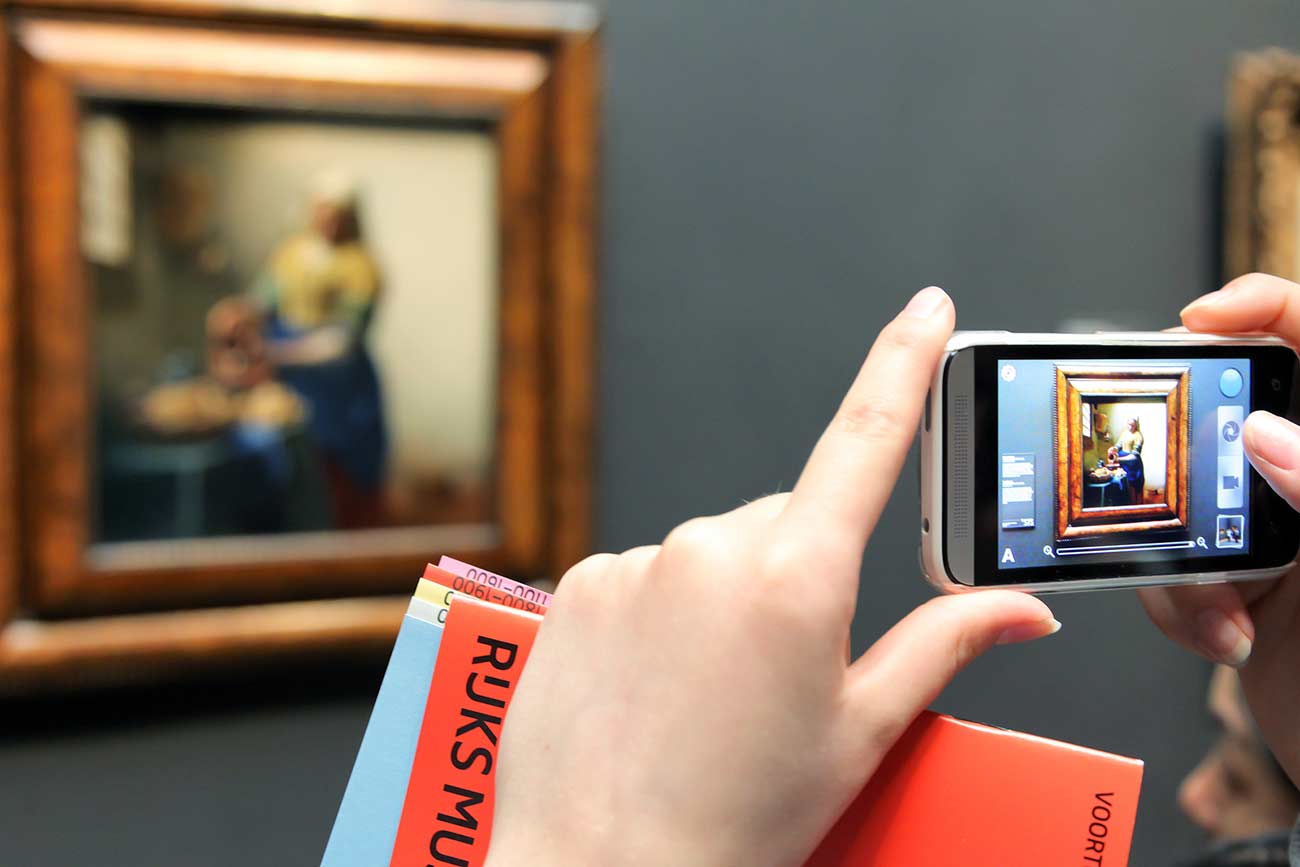
He left no notebooks, no letters, no records of his training, just 37 (by Rijksmuseum’s count) canvases plus five possible others mentioned through other sources in the 17th and 18th centuries. It’s estimated that perhaps he painted as many as 45 or 50 total (an output of two a year), but that’s speculation; against Rembrandt’s 350 works, there’s quite a gap. Yet mention “Girl with a Pearl Earring,” or “The Milkmaid,” and around the globe, people will reply, “Vermeer.”
In 2023, Amsterdam’s Rijksmuseum, partnering with Den Haag’s Mauritshuis, assembled from the world’s scattered holdings 28 Vermeers; the largest Vermeer monograph exhibit to date, drawing record-breaking attendance. (One included in the 37 is “The Concert,” stolen — never recovered — March 18, 1990, from Boston’s Isabella Stewart Gardner Museum. Valued in 2015 at $250 million.)
Putting this exhibit together was a years-long effort, interspersed with COVID, which, as these two books recount, offered a unique opportunity not only to photograph the paintings for the catalogue, but also to examine them with the newest, non-invasive technologies to glean new information and to discover what lies beneath the surface. Their findings led not only to a magnificent catalogue volume concerning the exhibit — “Vermeer” — but also a second that detailed those new techniques — “Closer to Vermeer.” Both are extensively illustrated, sometimes in a highly unusual manner.
“Vermeer” opens with illustrations of all the accepted canon, the exhibit pieces rendered at 1/10th actual scale. There are the expected large illustrations, together with images that at first glance look like topo maps or impressionist works. Examined closely, an illustration then reveals the fine lines actually are aged surface craquelure, a patch of color, a swatch of cloth in extreme closeup. The cover of “Closer to Vermeer,” for example, shows a thickish thread of white over a dark background, half-encircled by a lighter curve. It takes a moment to recognize the white as milk pouring from the Maid’s jug over the rim of her cooking pot.
Both volumes are published by Thames & Hudson, their texts composed by teams of specialists on their chapter’s subject. “Vermeer” is edited by Pieter Roelofs and Gregor J.M. Weber; “Closer to Vermeer” is, as advertised, “at once scholarly and accessible,” covering not only the latest technology, but Vermeer’s own life as perceived through the objects he painted (those letters, those pearls …) Did Vermeer, asks one essay, rely on optical devices?
What lay beneath the surface? “Girl with the Red Hat” (painted on board, not Vermeer’s usual canvas) is one example. It was discovered in 1994 that, when turned 180 degrees and examined through existing technology, there was an underlying man in a black hat. With today’s new chemical imaging, a clearer image has been enhanced — down to a molecular level — giving further information about Vermeer’s brush strokes and paint, and a clearer image of the man himself. There is a detailed explanation for the technologically savvy, written in a manner that even the lay reader can grasp the salient points and marvel at the information to our knowledge.
Vermeer continues to intrigue with the things he does not say. His subjects are suspended on their way to … where? The young woman and her letter; the maid watching with a knowing look. What does each know? What’s gone on before, what will happen next? Unlike images of other artists depicting great activity, Vermeer caught suspended moments that still pose questions to the viewer 3 1/2 centuries on.
The volumes are solidly crafted and constructed to stay with the reader, to be savored over time. Perhaps Vermeer’s relatively limited output, while frustrating to a world wishing there were many more, offers enough food for thought for the 37 to be sufficient. Why did he feature so few male subjects? One of the few with a single male subject is (along with its brother “The Geologist”) “The Astronomer.” Straightforward, didactic each might seem, but why, many still ask, did Vermeer not paint his astronomer a telescope, a primary — and existing — tool of the trade? Instead, seated, the Astronomer’s fingers reach out to brush a celestial globe, an instrument containing constellations and zodiac signs. Does that represent an inner cerebral interest over direct visualization? Viewers were caught in the moment then and remain so today and on into the future.






5200 Willson Road, Suite 316 • Edina, MN 55424
©2026 Lavender Media, Inc.
PICKUP AT ONE OF OUR DISTRIBUTION SITES IS LIMITED TO ONE COPY PER PERSON