


What Moves Max Vasilchuk
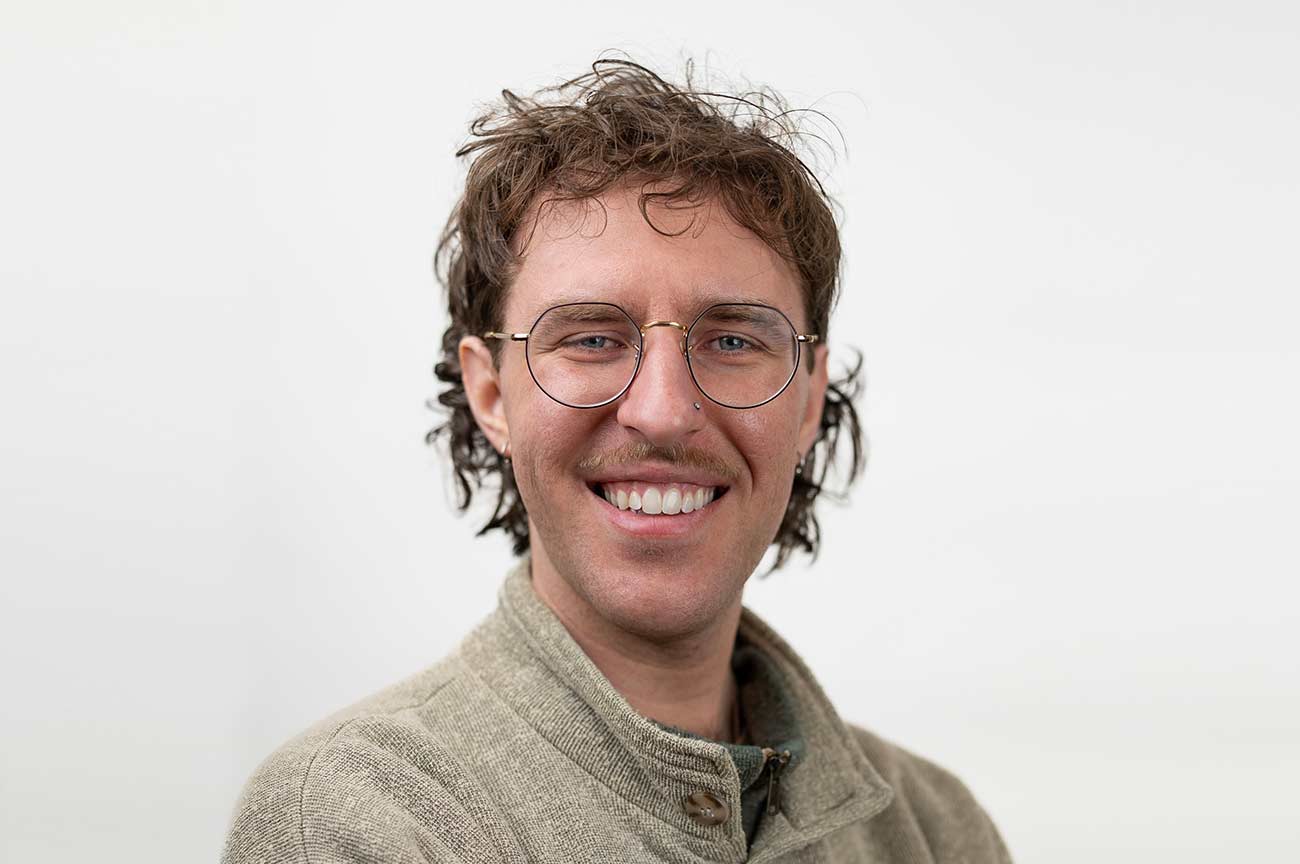
“I prayed, ‘God, if I live my life as a queer person and I love with all of my heart, as I’ve been taught and as my religion teaches me, how can you send me to hell? If all of my life is centered around love, how can I go to hell for this? For loving truly and freely.’”
Max Vasilchuk was born in Ukraine, but moved to California along with their family when they were just nine months old. They don’t have any memories of their home country, which they say they’re often asked about.
They grew up in Sacramento and the Bay Area — mostly Sacramento. They liken their relationship to their hometown to that of the protagonist of Greta Gerwig’s “Lady Bird” (which, for those who haven’t seen it, is set in Sacramento).
“My journey with my hometown is similar with the protagonist’s in [“Lady Bird”], where you kind of just grow up hating your hometown,” Vasilchuk says. “At the end, she kind of realizes that she appreciates where she grew up. I haven’t gotten to that place. I’ve never really liked Sacramento.”
Vasilchuk was brought up in a conservative, religious household. They also knew they were not straight from a young age — at least 8. As one might imagine, this combination created tension in Vasilchuk’s life.
That tension would stay with them throughout their childhood and eventually follow them to college. Vasilchuk attended a private Christian university in Minneapolis, where their Californian pastor had recently moved to become the university president. They also wanted to experience all four seasons and, of course, get far away from Sacramento.
“I was very much in the closet when I went to college,” Vasilchuk says. “My expectation for myself was to just stay in the closet and maybe be single for the rest of my life, or kind of pretend to myself that I was. That I wasn’t my sexual identity, that I wasn’t queer, and maybe marry a girl at some point that I get along with.”
Despite the tension they felt between their budding queer identity and the conservative interpretation of Christianity they had grown up in, Vasilchuk chose to major in religious studies (with a minor in ancient Greek literature). They wanted to learn more, hoping to conduct research post-grad and one day become a professor.
In the religious studies program, Vasilchuk got a taste of academia, getting the chance to present research papers at conferences. They studied Christian theology and scripture, as well as other religions.
“A big part of my life journey is searching for wisdom wherever it exists,” Vasilchuk explains.
That search led them to apply the methods they had learned in their coursework to a deep study of the Bible passages used by some Christians to discriminate against LGBTQ+ people. Vasilchuk had learned that cultural and historical context are key to interpreting scripture, which is shrouded in subjective translation decisions and thousands of years of cultural evolution.
“I was looking into the passages that many Christians will use to either demonize the queer community, or to say that it’s wrong or that saying that queer love is wrong,” they recall. “I discovered that things weren’t adding up from what I was told.”
“And I kept on studying those passages, and I found that there was no reason for me to feel ashamed of my identity or to hide it, that these were passages written in a certain context, and that context is not the same context that we have today,” they conclude.
Then, finally, after a lifetime of wrestling with the tension between their faith and their identity, and after years of studying the scripture that was the source of that tension, Vasilchuk was able to say the prayer that opened this story.
“That was a tipping point where, as I said those words, I made the conscious decision to be proud of who I am in my sexual identity,” they say of the prayer.
Vasilchuk thought that once they came out as gay, they’d feel a sense of relief and that the tension they had felt for nearly their entire life would be gone. That was not the case.
They continued to feel that something wasn’t right. Eventually, they became friends with a nonbinary person. This friendship opened Vasilchuk’s eyes to something they hadn’t considered for themself before.
“It wasn’t just my sexual identity that I need to come out with — I don’t feel cisgender either,” Vasilchuk recalls. “That gender identity journey took a little bit, but I think I finally settled on nonbinary, or genderqueer, or however. Depending on the context, I kind of oscillate between those two.”
With that realization, and with a move to a more welcoming and inclusive church than the one they had grown up in, Vasilchuk was finally able to begin to ease the tension that they had wrestled with for almost their entire life.
Today, Vasilchuk works not as a professor, but as the aquatics director at the St. Paul Midway YMCA. They began working at the Y as a swim instructor as a second job, but decided to stay long-term after they found that both the role and the Y’s culture deeply resonated with their values.
As a swim instructor (and now aquatics director), they’re able to pursue their passion for health and safety and compliance.
“It sounds a little nerdy,” Vasilchuk says, but their work is centered around setting things right, which satisfies an orientation toward justice that they’ve held since they were a child.
As for the Y, it, too, is in line with their pursuit of justice — the YMCA of the North is the only YMCA chapter in the U.S. to add “equity” to the YMCA’s core values of “caring, honesty, respect and responsibility,” according to Vasilchuk. They are on the YMCA of the North’s Equity Advisory Council.
Additionally, Vasilchuk is a member of the Y Pride LGBTQ+ employee affinity group, where they’re able to “create a safe space for other queer professionals to come together and be able to just be ourselves around our own community,” they say.
As for what’s next, Vasilchuk wants to continue to move up within the Y in order to positively impact as many people as possible.
“I want to stay in the YMCA because I love all the programs that the Y does and the values that they stand for,” Vasilchuk says. “When I first started at the Y, I didn’t know that there were programs for families in crisis, for kids in crisis. Like Beacons is an incredible program. It’s an after-school program for kids in the city. And I’ve met people who said that that program has literally saved their life. And I want to continue working for an organization that has programs like that for people.”
“I don’t have a particular plan about how I want to go forward as long as I can impact people,” they continue. “And I’m going to keep on moving up until I’ve reached maximum impact.”
The YMCA of the North is currently running a campaign called “What Moves You,” highlighting the stories that inspire people in their community, and it is through this campaign that Vasilchuk’s story reached Lavender.
Vasilchuk said one story that inspires them is the “starfish story,” a parable about a young boy who walks along a beach, throwing starfish back into the ocean one at a time. When an old man tells the boy that he’ll never be able to save them all, the boy replies, saying that even if he doesn’t save them all, every one that he does save makes a difference.
In their office, Vasilchuk has a “starfish wall” where they save notes from people who say Vasilchuk has had an impact on them, as a reminder of the impact they can have.
By sharing their story, perhaps Vasilchuk can move many Lavender readers into the ocean where they belong. But, even if it only changes one person’s life, they’ve still made a difference, just as they already have in the lives of their students, coworkers, friends and family.





5200 Willson Road, Suite 316 • Edina, MN 55424
©2026 Lavender Media, Inc.
PICKUP AT ONE OF OUR DISTRIBUTION SITES IS LIMITED TO ONE COPY PER PERSON