


The Reality of Being A Furry
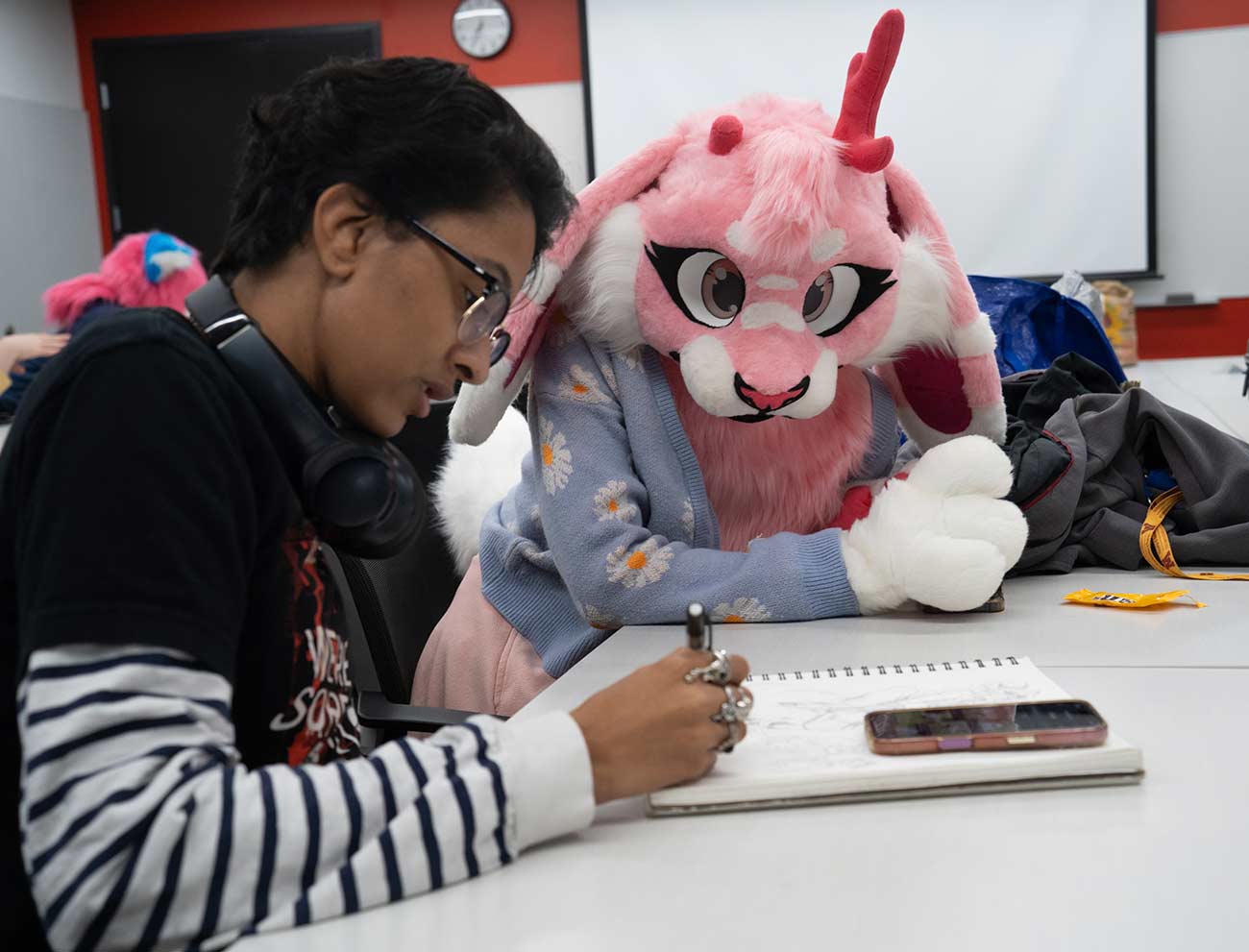
Though many stereotypes exist about furries, the true lived experiences of Minnesota furries tell the story of a passionate, supportive and intelligent community.
On a chilly fall evening, members of the University of Minnesota Twin Cities Anthro Club entered the large classroom in the Phillips-Wangensteen building, where two students were already studying.
“We have this room reserved for a club, sorry,” says Zachary Wesley, the president of the club. “But you’re welcome to stick around and hang out if you want to.”
The room was more than large enough to accommodate everyone. The two students removed their headphones and looked up from their laptops.
“What club?” one of them asked.
“Furries,” Wesley answered.
“What?” They gave him a puzzled look, as though they had heard him wrong.
“Furries.”
The two laughed and gave each other an uncomfortable glance. They quickly packed up and left.
Who knows if their haste was in response to the myriad stereotypes that have proliferated for years online about furries — people who enjoy anthropomorphic animals, or animals given human traits and personalities. Some believe that being a furry is a kink, labeling it as “deviant.” Others assume that furries genuinely believe that they are animals, or that they are sexually attracted to animals. Sensationalist news stories promoted the false narrative that teachers were pressured into accommodating the needs of students who have this identity. Some also assume that all furries are mentally ill, or that their interests stem from neglect or abuse at an early age.
“I still get comments about the litter box thing,” Wesley says, referencing an online rumor about students requesting litter boxes in classrooms because they identified as cats.
Most members of the club shared similar awkward experiences when trying to explain their interest to people outside the furry community.
“I had to cut off some of the most important misconceptions right at the pass,” says Allison Rausch, who recalls showing off her furry art to her aunt only to be asked if it was a kink. Rausch, who uses she/they pronouns, found that laughable.
“Why would I want to show my art to you if it was a kink?” she says.
Furries in Context
Though it can be easy to believe that the appeal of furries is a new phenomenon or that it is relatively elusive, this is far from the case. Animals given human traits or physical features have a longstanding presence in storytelling, according to Furscience, a group of scientists that specializes in the study of furries.
Fairy tales, mythology and art have all featured anthropomorphizing over centuries across numerous cultures. Stories from the Chinese zodiac to Aesop’s fables have all used animals to be stand-ins for human characters in order to more easily express a desired moral or message. The portrayals in works like the fables of Aesop would eventually give way to the funny animal cartoons of Walt Disney and the like in the 20th century, as technology expanded. In the 1980s, the term “furry” was coined by science fiction writers Mark Merlino and Rod O’Riley, who shared an interest in these unique animal characters.
At the UMN Anthro Club, 20 to 30 people show up to each meeting on average, but the online Discord server has 185 members. Across the internet, there are many who might identify as a furry, but finding an exact number of people is difficult. Many people who are interested in the furry community do not advertise this interest online out of fear of ridicule or a lack of interest in internet spaces.
At their most harmless, misconceptions about the furry community lead to awkward conversations based on a lack of understanding. However, at their worst, they can quickly lead to people harassing furries for their interests. Though most attacks against furries take place online, there have been attacks against furries in person. An intentional chlorine gas leak at Midwest FurFest 2014 in Chicago led to the hospitalization of 19 attendees.
Since Rausch started actively participating in online furry spaces a year ago, she has been berated with online attacks. Some accused her of being mentally ill for dressing up in costume, while others made violent threats, alluding to “hunting season.” A commenter on one of Rausch’s posts claimed that because they belonged to both the furry and LGBTQ+ communities, they “touched kids.”
Instead of allowing accusations to dissuade her from posting online, she makes jokes. For instance, when commenters try to claim that she is unloved, she responded with a video where she pointed to her parents and said, “Nope! My parents are right over there, say hi!”
Club environment and community
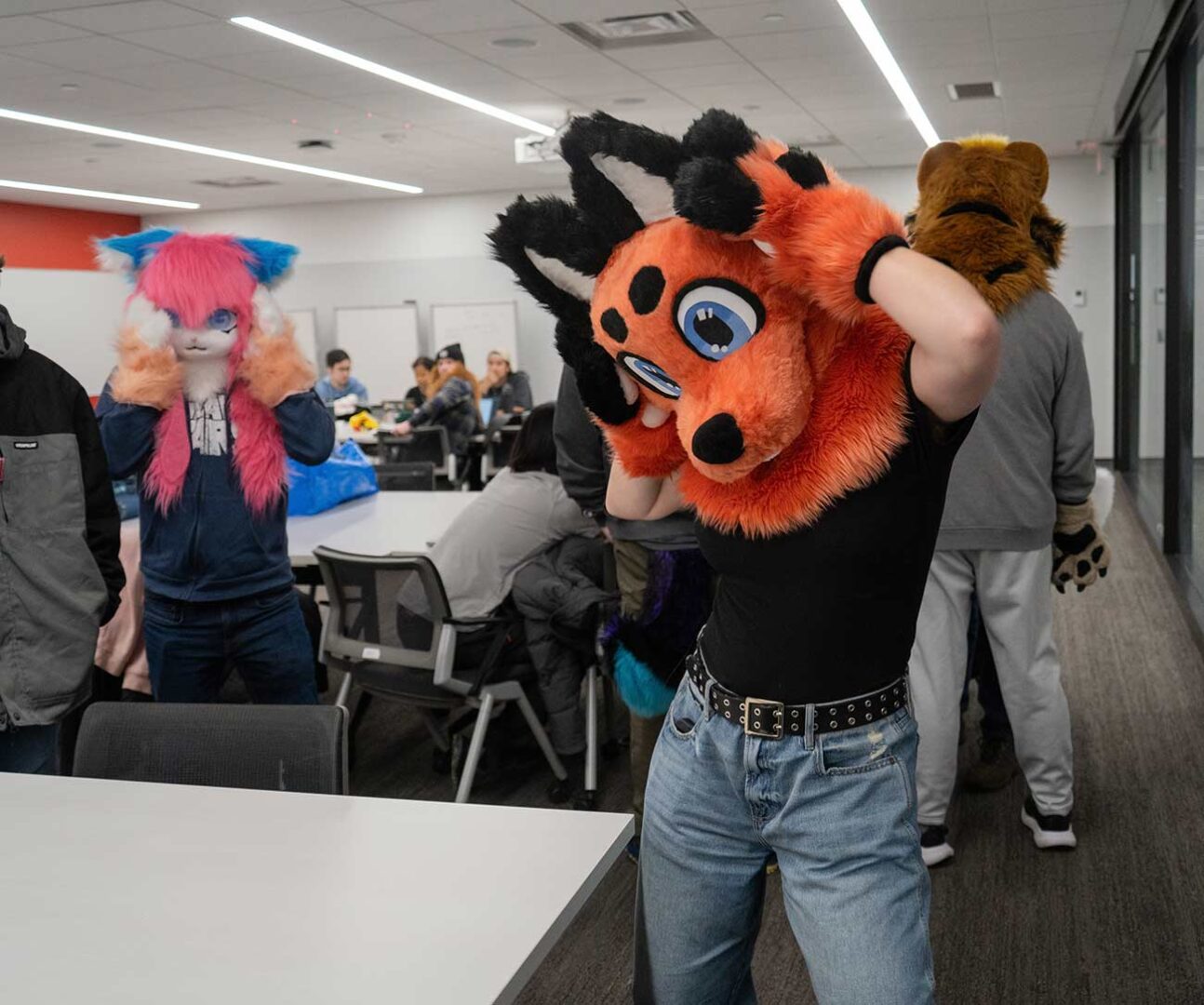
The discrimination against furries has resulted in a resilient and accepting community at the University of Minnesota Anthro Club. At a mid-October meeting, Rausch eagerly waved over shy newcomers to join the circle and chat with everyone else. Those who had costumes often showed them off, despite occasional stares that they received from students passing by the room. Such stares are met with laughter or sassy waves. Piles of snacks and candy sat on the tables on one side of the room, and people tossed bags of candy to one another without pausing ordinary conversation.
The club room during most meetings is full of energy. Sometimes students will yell across the room to one another if they overheard a conversation of interest, as previous circles of conversation dissolve and reform without any sign of traditional cliques.
Via Carney, another freshman at the club, was new to the furry community at large and felt immediately at home in the club’s chaotic but friendly atmosphere. Though she had her hesitations at first, Carney first became interested in the club due to the way that her old friend, Nick Gromova, always talked about the club and about furries, as they had been involved in the community since middle school.
As both a freshman and a commuter student, Carney struggled to make friends at college, feeling as though they were missing out on important parts of the college experience. On Oct. 16, they attended their first club meeting alongside Gromova. They recalled their father giving them a grim warning before they went, insisting that they “be careful.” It didn’t take her long to realize that such worry wasn’t needed, as she was welcomed with open arms.
“I was like, ‘Holy crap, people talk to me here?’” Carney says.
The art of the costume
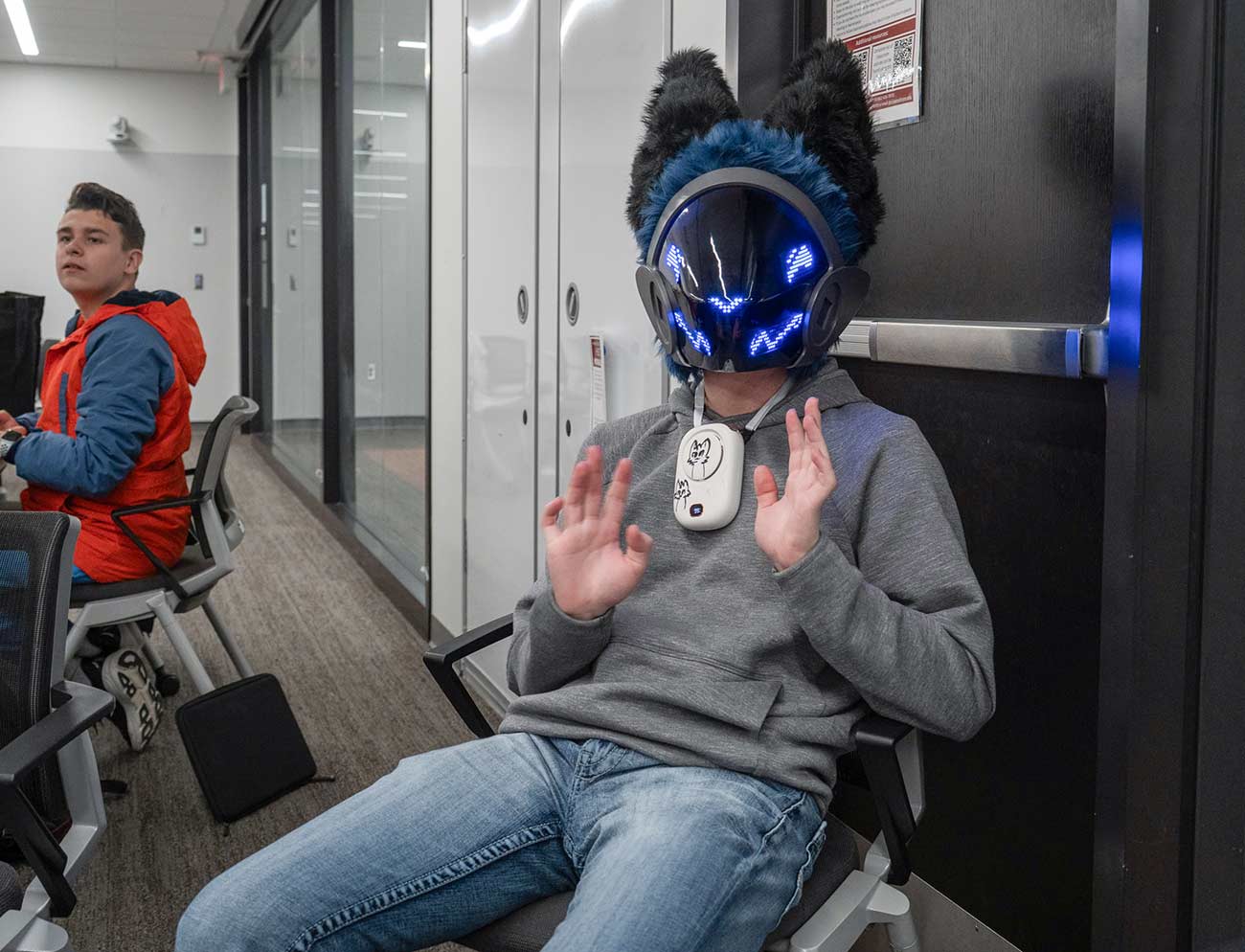
Furry art, especially furry costume making, anchors the community. Meetings are spent making art and sometimes wearing animal costumes that members usually design to reflect their identity or a chosen character — otherwise known as fursuits. Roughly 10-20% of the Anthro Club’s members have a costume of some kind. The complexity of costumes at the club varies: some only have clip-on tails or a headband with ears, while others have masks or paws. However, none of the club members has a full-body costume.
Some furries will buy their own costumes, but getting a custom fursuit can cost thousands of dollars. As a result, most will opt to make their own. Fursuits can be made of a variety of materials, such as foam, fabric, cardstock or even cheap store-bought dinosaur masks. For many furries, the art of making a fursuit or costume is one of the most exciting parts of being in the community.
“It feels like a whole different community once you have a suit,” Rausch says.
Rausch commissioned a Texas-based artist to have a costume of her fursona — a furry character designed to be a stand-in for oneself, either online or in person — made and sent to her. Princey, Rausch’s fursona, is a bright pink, friendly jackalope with big floppy ears, white detailing and red horns. The costume was expensive, but for the quality of the materials and the craftsmanship, she knew it would be worth it.
Rausch recalls the day when she first unboxed it with reverence and nostalgia. Her friend Rowan, who introduced Rausch to the furry community, hovered behind her with anticipation. Seeing the costume’s paws alone already sent her over the moon, and she immediately put them on to show off to her equally ecstatic friends, temporarily forgetting that there was another part of the costume to look at. Her favorite part of the costume, however, was the jackalope’s face and especially the pink stuffed horns on top of her head. To her, the design of Princey’s horns — with one being broken — was one of the most important parts of the character to get right. Seeing the horns in person, recreated exactly as she imagined, was incredibly rewarding.
Designing costumes from scratch can be equally rewarding. Gromova explained that the process of making their own costume was a lot of trial and error. Though he had years of experience making cosplay — performance art involving dressing up as characters from movies, cartoons or video games — they had never made a fursuit before their current wolf-fox costume.
The process was grueling and involved feverishly following tutorials on YouTube, but in the end, Gromova was thrilled with the final result. Starting with a bucket-like shape made from foam, they layered additional foam pieces on top to shape the head into something more closely resembling an animal’s snout and ears. Throughout the process, they would frequently try on the mask and paws, which would only stoke the flames of their excitement to see the finished product.
Mental Health and Healing in the Furry Community
Rausch, Gromova and many other furries in the club agreed that the main appeal of dressing up in costume is the opportunity it provides for self-expression. Contrary to the claims of online trolls and fearmongering news stories, most furries do not genuinely believe that they are the animals that they dress up as, nor would they openly identify as such. The majority of those who identify as furries are aware that they are human, according to Furscience. Instead, the purpose of the costumes — in addition to being fun to wear — is to help people socialize. Many people in the furry community struggle with social interaction in some form or another, according to Gromova. Being able to assume an alternative identity to interact with others helps people overcome social anxieties and communicate better.
Being a furry serves as an act of healing in itself, which was Rausch’s experience. When she was 14, her mental health worsened and culminated in depression and a life-threatening eating disorder. For the next several years, she would spend over half of her time in a psychiatric hospital. Though she was placed in one of the best facilities for people with this condition, it was still a difficult place for a young person to spend time during such an important stage in their development. She was unable to contact friends due to the strict rules at the hospital. Patients were discouraged from looking at themselves in the very few mirrors that were present in the hospital, leading to Rausch not feeling connected with her body as she went through puberty.
Princey, Rausch says, was created as a part of her coping strategy from the impacts that her mental health struggles have had on her life. Princey’s broken horn, for instance, was designed as a direct reference to Rausch’s eating disorder, as hair and nail loss are common symptoms in such conditions.
“She is who I thought I was going to be when I was younger,” she says. “I wouldn’t say that I would like to be a version of me that had never been [in the psychiatric hospital], because it made me who I am today, but I wouldn’t say that I ever want to be there again.”
Though she has only been involved in the furry community for a year or so, her time within it has improved her life drastically. Being a part of the Anthro Club at college has been especially helpful, as it provided a place to make friends who were less likely to judge her.
“The club helps me feel like people know about my existence,” she says.
Most furries — over 70% — rarely meet up with other furries in person, according to research by Furscience. This is primarily because very few places exist for furries to openly meet up outside of occasional conventions. Opportunities to make real-world connections with other furries are all the more important as a result.
End of the semester
As the semester comes to a close, so do the weekly Anthro Club meetings. The final meeting of the semester, “anything but finals,” offers club members some time to relax, unwind and do arts and crafts before the stress of final exams.
During this final club meeting of the semester, once again, students had been using the space to work on finals that were not a part of the Anthro Club. About 15 minutes into the club meeting, the two girls packed up their laptops and notebooks and hurried out. Though this time, it was most likely due to the blaring sounds of Mario Kart over the projector speakers and the cackling of students watching the game unfold.
Piles of canvas boards were stacked high at the edge of the central table, and students quickly got to work drawing all sorts of designs from fursonas to Dungeons and Dragons characters to Kirby eating a traffic cone. The one constant in the chaos and commotion of the club was the support that club members had for one another, aside from perhaps an occasional jeer at someone’s poor performance in a game of competitive Tetris.
Like many of the activities of the Anthro Club, there’s nothing inherently out of the ordinary about the club aside from the interest that brought the group together.
Gromova has learned that most people are fairly open about furries and are willing to get to know them before judging them. The club has attended several furry conventions, even wearing their fursuits in public on occasion. Those who knew nothing about furries were often the kindest and most supportive of the hobby. A pair of elderly women on the bus, for example, were fascinated by Gromova’s costume and furry art when they were shown it online. In all, it was a validating interaction, Gromova says.
“If [people] don’t have a preconceived notion about furries, most are pretty chill,” they say.
In the end, Gromova realized that the majority of people are fairly open about furries, assuming that those people are willing to take the time to get to know them, rather than writing them off at first glance.




5200 Willson Road, Suite 316 • Edina, MN 55424
©2026 Lavender Media, Inc.
PICKUP AT ONE OF OUR DISTRIBUTION SITES IS LIMITED TO ONE COPY PER PERSON