
The Bones of University Baptist
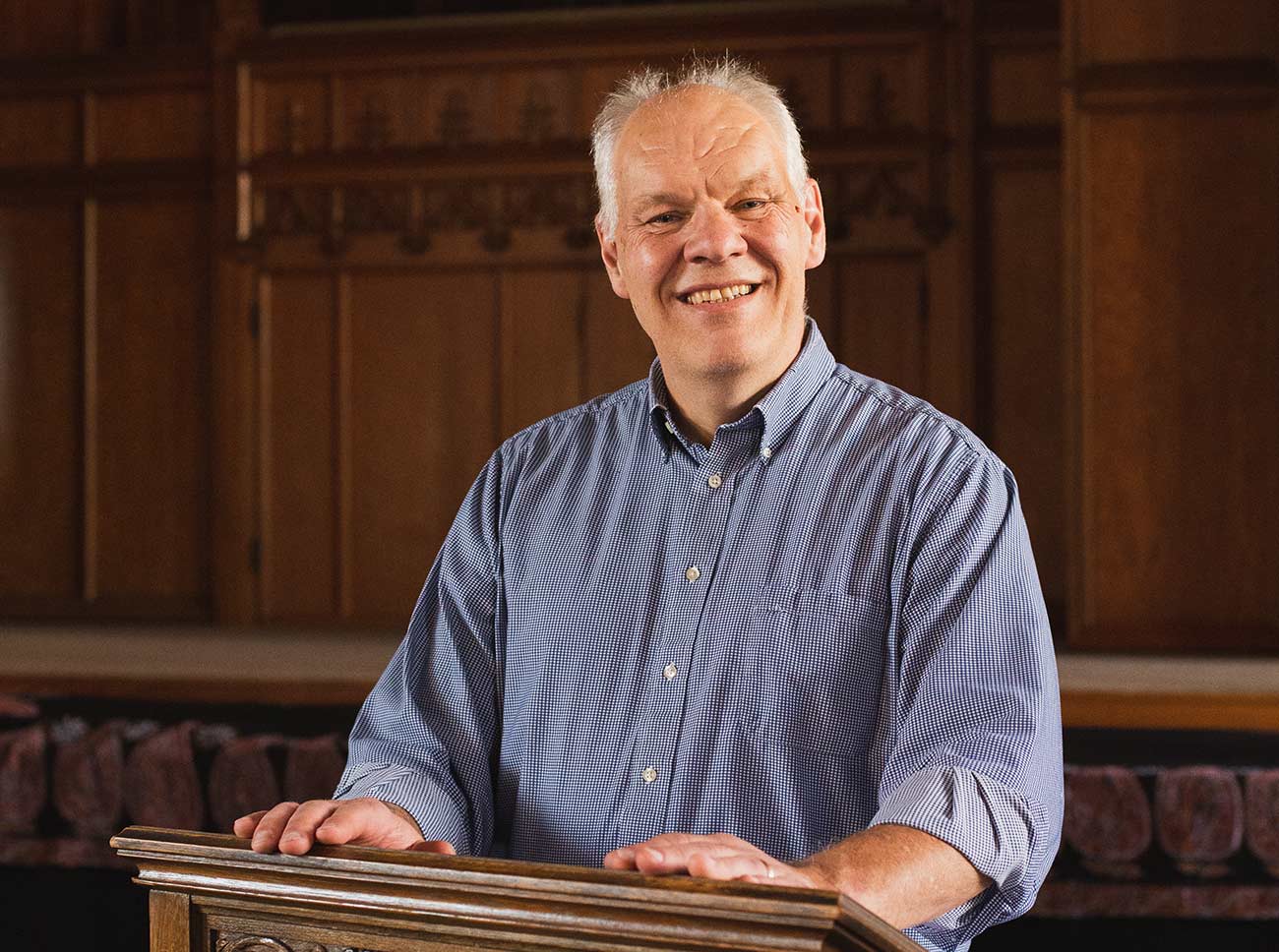
Rev. Doug Donley retires after 25 years at University Baptist Church in Minneapolis and a lifetime of fighting for justice around the world
The offices of University Baptist Church in Dinkytown, Minneapolis, are in a state of carefully contained chaos. The unmistakable scent of old paper heralds a line of cardboard boxes stacked on wooden chairs, full of old books on offer to anyone who passes through the narrow hallway. Yet more boxes litter the floor of the office of the pastor, Rev. Doug Donley. Even with what seems like dozens of boxes filled, the floor-to-ceiling bookshelves are still well-stocked, as if they can’t quite accept what’s happening — after 25 years of service at UBC and 37 total as a pastor, Donley is retiring.
Donley grew up in Cleveland and got his undergraduate degree at Denison University in central Ohio. He then worked at the university for three years before beginning seminary at Union Theological Seminary in New York City.
However, before his 1989 ordination and the beginning of his career as a pastor, Donley was twice denied ordination by the Columbus Baptist Association. He had been asked what he thought were the five most important domestic issues for the church to address.
“And what I said was, well, I’m living in New York City, and so I have to say what I see. What I see is homelessness, hunger, racism, sexism and homophobia,” Donley recalls. “And I was sitting on a couch next to this guy, he kind of moved away from me … They were just horrified that I would say something like that.”
Donley’s refusal to denounce homosexuality as a sin resulted in those two denials before his eventual ordination. This insistence on standing by his beliefs would become a common theme throughout the rest of his career.
Where does that conviction come from? Donley replies quickly, although not in a way that suggests he was anticipating the question, but rather as if he’s considered it himself at length and is confident in his answer.
“I’m a musician, and believe it or not, there’s a lot of gay people in the music field,” he says with a laugh, before quickly returning to the more serious demeanor one might expect of a clergyman of three-plus decades. “You know, some of my very dearest friends are in the queer community. And I learn a lot from them, and it breaks my heart to see them be vilified, especially way back in the ‘80s, by larger church bodies.”
Donley brought his conviction in his belief that all people, including LGBTQ+ people, are deserving of love and respect to his first two positions, at Asylum Avenue Baptist Church in Hartford, Conn., from 1989 to 1994 and Dolores Street Baptist Church in San Francisco starting in 1995.
From the very beginning of his career, Donley did more than just preach to his congregation. He was a founding member of the Baptist Peace Fellowship of North America, where he helped gather, equip and mobilize justice-seekers across the Americas and around the world. He served in several roles there, including as president, and has traveled across the world to further their mission.
He was also an original member of Soulforce, an organization co-founded by Mel White and Gary Nixon in 1998 to oppose religion-based spiritual violence against LGBTQ+ people using the principles of nonviolence. In the following years, they directly challenged homophobia in the church, including a highly publicized meeting with influential televangelist Jerry Falwell where 200 Soulforcers and 200 of Falwell’s conservative evangelicals held a forum on spiritual violence against LGBTQ+ people.
By 2001, Donley was ready for a new home base from which to continue his work.
“I let the wider circle of people know that I was looking for a change, and University Baptist came calling,” he recalls.
UBC was looking for a successor to Rev. Dr. Nadean Bishop, its first woman and first lesbian pastor. She had established UBC as a Welcoming and Affirming congregation, part of an organization of LGBTQ+-affirming Baptist churches in the U.S.
Donley says his history of advocacy for LGBTQ+ people, from his defiant stance during his ordination process to his work with Soulforce and Dolores Street Baptist’s reputation as LGBTQ+-affirming, were attractive to UBC. He became its new pastor in March 2001.
Over the next two-and-a-half decades, the faith UBC placed in Donley’s capacity for resistance and advocacy would be rewarded time and time again.
An early test of the new pastor’s mettle came in 2004, when UBC and Judson Memorial Baptist Church in South Minneapolis brought LGBTQ+ candidates for ordination. Mid-American Baptist Churches, the church region that UBC and Judson Memorial belonged to, blocked those ordinations.
“The region put roadblocks up to that because both these people were queer. And so, the weird thing was, this is 2004, they said, ‘We can’t recognize the ordinations because we don’t have a policy on gay ordinations,’” Donley says. “So, well, you don’t have a policy against it,” was his response.
“And so they said, well, let’s table it so until we can come up with the policy,” he continues. “And then they came up with a policy, and the policy was that the practice of homosexuality is incompatible with Christian teaching, therefore we will never recognize the ordination of a gay or lesbian person.”
Following this decision by Mid-American Baptist Churches, both UBC and Judson Memorial left the church region and, in 2006, joined the American Baptist Churches of the Rochester/Genesee Region, which was renowned for being progressive and accepting.
Under Donley’s leadership, UBC continued to advocate for the LBGTQ+ community and was one of the first churches to support the legalization of same-sex marriage. Donley’s voice joined the voices of other clergy members singing in the Minnesota State Capitol rotunda while representatives voted on marriage equality.
UBC also fought for other marginalized communities, both in Minneapolis and abroad. The church declared itself a sanctuary congregation in 2016, promising to be a safe space for undocumented immigrants. It developed a relationship with a sister church in León, Nicaragua, with which they exchanged visits and support, although political changes in both Nicaragua and the U.S. have made continuing the relationship difficult.
What Donley calls “some of the proudest work I’ve seen us do collectively” came after, albeit barely so, he announced his retirement in January 2026. As the Twin Cities community rallied to take care of itself during Operation Metro Surge, UBC became a hub for community organizers.
“We got a big ol’ building, and so we used the building to be a center for activism,” Donley says. “We didn’t feel like we needed to create a new program. Rather, we needed to augment the other programs that were already happening in the Twin Cities. There’s enough organizations, enough nonprofits doing good work.”
That good work has been a model of Donley’s vision of the best version of Christianity.
“In these past several months, we’ve really seen, the Twin Cities step up and model what I think the best of what Christianity can be, whether they’re Christian or not, in terms of loving neighbor, being a moral center, and being brave and connected with folks,” he says.
Throughout the early months of 2026, the UBC congregation gathered on Sunday mornings to “sit here and tell our stories of our trauma and try to get a little more strength for the journey ahead,” Donley shares. A pneumonia infection in January kept Donley away from the action, but he returned to his community as soon as he could.
“I realized it was not gonna be healthy for me to be out in the streets. My soul was out in the streets, but my body was not,” Donley recalls. “But this is a marathon, not a sprint. And it’s a relay race. And so, when I got healthier, I tapped in and and spent a lot of the time being out, just augmenting other people’s voices and being the place to receive the trauma that people were bringing in, and the stories that people were bringing in.”
The UBC community’s collective experience of Operation Metro Surge culminated in a Good Friday procession to memorial sites for what Donley calls “present-day crucifixions,” including George Floyd Square and the memorial sites for Renée Good and Alex Pretti in South Minneapolis.
The procession is a fitting final chapter to Donley’s storied career — a show of community solidarity and nonviolent resistance to match the actions that helped bring him to Minneapolis and UBC in the first place. It gives him confidence he’s leaving the congregation in “a really strong place.”
Following Donley’s retirement, effective May 31, Rev. Dr. Cody J. Sanders, who also serves as the associate professor of congregational and community care and leadership at Luther Seminary, will take over as interim pastor at UBC. Donley will head to Scotland to hike, before returning home to the Twin Cities. He’ll take some time before returning to church life, staying away from UBC to allow his congregation to move on and his eventual successor to establish themselves without his 25-year-long shadow being cast over their pulpit.
Hidden in plain sight in one of the boxes on Donley’s office floor, there is a collection of bones that was found in the church attic. Contrary to what some would expect from a clergyman of three-plus decades, Donley does not hide the skeletons in his church’s closet. Instead, he shows them off with a grin that hides the years of experience on his face, making wrinkles and smile lines indistinguishable.
One of the bones — a long, thick femur, seemingly from one of God’s larger creations — is marked with a list of names. It is a roster of a group of activists like Donley, but from generations past. In the 1920s, they resisted the demands of Rev. Frank Riley of the First Baptist Church of Minneapolis to ban the teaching of evolution. When UBC refused to submit, they lost the opportunity to host the Minnesota Baptist Convention, for which the offices that Donley and his predecessors have occupied were originally built.
Instead of church bureaucrats, 100 years later, the offices on University Avenue are still occupied by people who refuse to abandon their beliefs, regardless of the consequences. Whoever is tasked with succeeding Donley will inherit that legacy. While Donley may not leave behind a fossil of his own in the church attic, thanks to his relentless pursuit of justice, the bones of his church are as strong as they’ve ever been.

5200 Willson Road, Suite 316 • Edina, MN 55424
©2026 Lavender Media, Inc.
PICKUP AT ONE OF OUR DISTRIBUTION SITES IS LIMITED TO ONE COPY PER PERSON