


More Than Money: How The National Rainbow College Fund’s Ongoing Support for LGBTQ+ Student Success Builds Brighter Futures for All
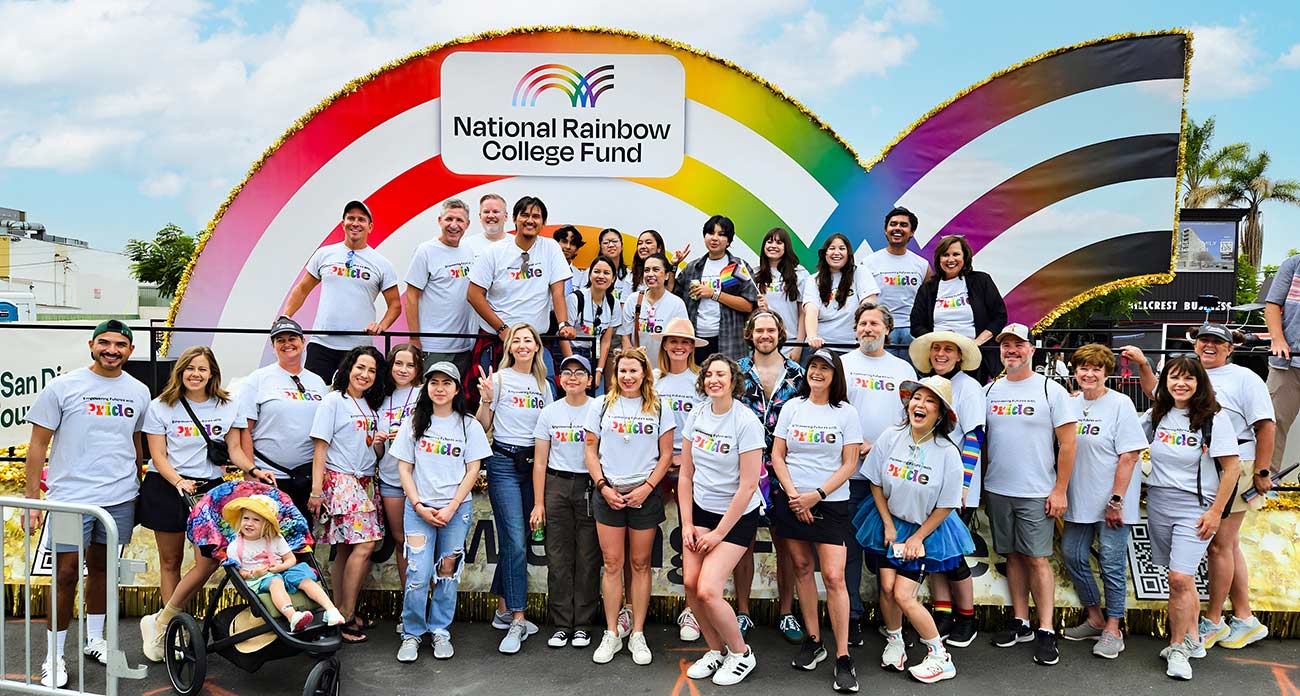
California is a state where one imagines it to be easier for students to come out; it’s an open environment, where the queer community is generally accepted.
Yet, 20% of LGBT students are staying in the closet until they’re financially secure, says Jeff Spitko, Senior Director of Integrated Funding at The San Diego Foundation.
The National Rainbow College Fund (NRCF) is the first program to offer scholarships to LGBTQ+ students, whether they are publicly out or not. Forty students in San Diego received scholarships amounting to $2,500 each during their 2024 pilot year. The program reached 140 students statewide in 2025 after receiving 540 applications from over 200 zip codes.
“I think for a lot of the scholarship programs out there, you have to be completely out and comfortable with your family knowing you’re getting a scholarship from the organization that’s granting this to you because you’re LGBTQ+,” Spitko says. “It can be really difficult to either come out and be comfortable with who you are, or having to get through acting and lying to your family and friends about who you love and who you are.”
Not only are there inequities in scholarship distribution, according to The Center for LGBTQ Economic Advancement & Research (CLEAR), nearly 32% of LGBTQ student borrowers in 2018 reported discrimination from a financial advisor or professional, highlighting disparities in loan approval toward the queer community.
The data proves it, and it’s undeniable that their straight counterparts are getting more financial aid, Spitko says.
On a federal level, many LGBTQ+ students are prevented from receiving aid, not due to academic shortcomings but rather because their families refuse to support them through the FAFSA process.
Without parental financial information, a student can’t complete the required sections of the application, and the form will not generate a Student Aid Index (SAI), which is a key metric used to calculate need-based aid, according to the National College Attainment Network.
Applicant privacy, equity and reach are all priorities of the NRCF, with the funds going either directly to the university or coming from San Diego Foundation and not necessarily NRCF, Spitko says. The program is applicable to all ages, whether they are planning to attend community colleges or vocational and trade schools, making it available beyond traditional four-year university applicants.
“When you are in a home where you feel like if your family finds out who you are or who you love, they will potentially walk away from you — that’s terrifying,” Spitko says. “Anything we can do on our power to be that sense of support as they grow into adulthood, or be a means of support later in life for individuals, means everything and more.”
Though still in its earlier stages, NRCF is already looking forward, hoping to expand its reach nationally and add ancillary services such as mental health counseling, peer counseling, career counseling and job placement services as students reach graduation, says Spitko.
“It’s critical for us to really be fully embedded if we want to run this program, which means understanding the world of the students we’re helping,” Spitko says. “It’s more than just writing a check and sending it off; it’s about being there for them when they need it.”
Spitko says the NRCF has worked with recipients from all paths of life, from students who were homeless or in foster care, to students who have been cut off from their families after coming out.
Beyond financial support, simply listening to the stories of applicants plays a large role in the foundation, whether it’s through periodic check-ins or following up on a response from one of the three essay questions in their application that touched them.
“What I love so much about this position and this program is that you are always inspired when you talk to these students and hear their story, their strength and their passion,” Spitko says. “That, to me, has just been so rewarding, and I feel honored and blessed to be able to work on this.”




5200 Willson Road, Suite 316 • Edina, MN 55424
©2026 Lavender Media, Inc.
PICKUP AT ONE OF OUR DISTRIBUTION SITES IS LIMITED TO ONE COPY PER PERSON