


Four LGBTQ+ Artists to Visit During NEMAA Art-a-Whirl 2026
These queer artists are turning trash into treasure, fully embracing their non-normative bodies and identities and following their creative passions wherever they lead
While May marks the beginning of tornado season in Minnesota, per the DNR, one whirlwind you don’t need to take shelter from is the Northeast Minneapolis Arts Association’s annual Art-a-Whirl. In fact, it’s more fun if you run headlong into it!
From Friday, May 15 to Sunday, May 17, over 1,600 NEMAA member artists, galleries and businesses will open their doors across more than 100 locations around the Northeast neighborhood in the largest open artist studio tour in the country. You’ll also see residents take advantage of the buzz by hosting garage sales, just in case there wasn’t enough to do already.
Several participating artists are part of the LGBTQ+ community, and they represent a variety of media, backgrounds and artistic perspectives. When you’re swept up into this year’s Art-a-Whirl, these four artists are more than worthwhile spots to land.
BOI TOY Studio — Northrup King Building, Studio 400A
When Black transmasculine photographers BEARBOI (or just Bear) and Wordsworth Musinguzi (or just Word), the brains behind BOI TOY Studio, first moved into the Northrup King Building, their studio felt more like a supply closet — not ideal for a photography studio and collaborative creative space.
“We were just keeping things in there and not really producing things, gathering people together,” Word says. “It was very cold.”
Their new space, however, which officially opened during last year’s Art-a-Whirl, is much more inviting. The warm lighting, creaky old wood floors and bright white walls covered in their work were a welcome reprieve from the rain when I came to visit them.
“(This space) felt more intimate,” Word says. “We both love public presentations, exhibitions and sharing our work with our communities. We’re creators, and we’re curators as well.”
A welcoming spirit is crucial for what BOI TOY Studio seeks to do: provide a safe, caring space for emerging Black, queer, trans and gender-nonconforming creatives to express themselves.
“We are two Black transmasc photographers that are coming together and opening a space where people who are often seen as invisible, sometimes like ourselves, are able to come in and take up space,” Word says.
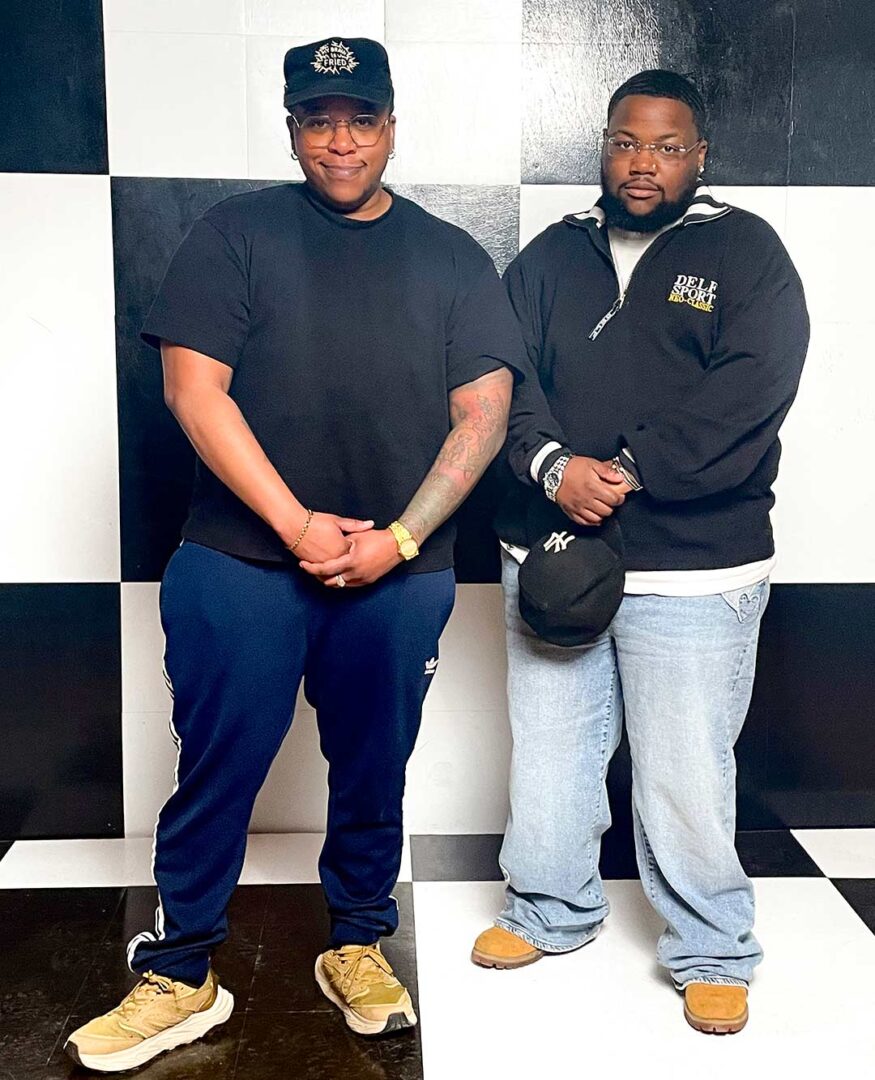
Word adds how photography in particular demands vulnerability from people, especially as it’s used as a surveillance tool against the marginalized, making spaces like BOI TOY all the more crucial.
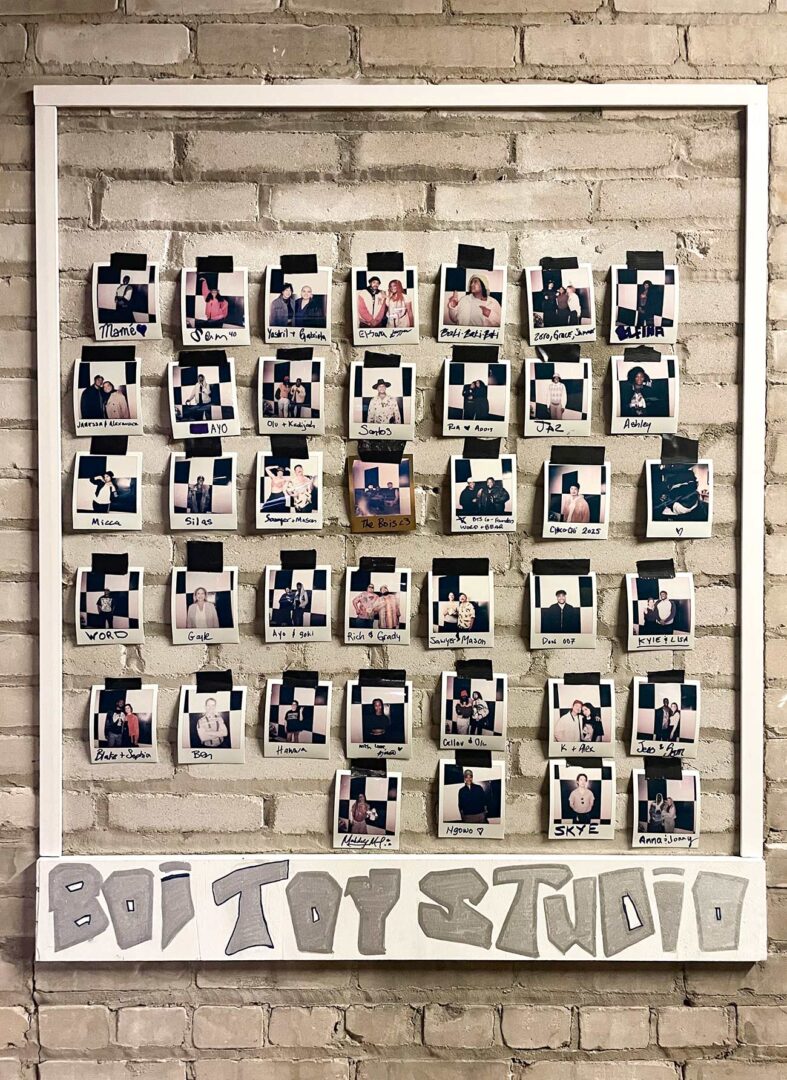
For their grand opening last year, Bear and Word took polaroids of their visitors, which now hang on the wall opposite the gold doors of their studio. What they’re most excited for this year is live-printing photos onsite with their large-scale EPSON inkjet printer that Bear got for free from a drag queen on Facebook Marketplace.
“Something that’s really beautiful is we’re trying to do a lot of things in-house,” Bear says. “There’s also definitely a deeper appreciation to art when it’s not on a screen, either.”
A word to the wise: despite its name, BOI TOY does not sell toys for children or adults. But Bear and Word do invite folks to come visit during Art-a-Whirl and “world build with some wonderful Black and trans folks.”
Bear and Word are also hosting a mixer centering Black trans men on the opening night of Art-a-Whirl and will be DJ-ing back to back. So come for the party, and stay to find out what’s possible.
Bee Makes Fart — Northeast Tree House
A name like Bee Makes Fart definitely stands out among the droves of professional artists and fine galleries participating in Art-a-Whirl, but Bee Marshall’s found object tableaux are by no means short of intention or creative spirit.
Marshall, a 27-year-old surgical technologist, came up with the name for their artistic practice when a co-worker confidently informed them that farts weren’t funny, which, they say, “just isn’t true.”
“It made me form the connection of like, you can either view something as a piece of trash on the ground or something that you can put into art,” they explain. “And you can view farts as something gross, or you can view it as just a regular bodily function that can be funny sometimes.”
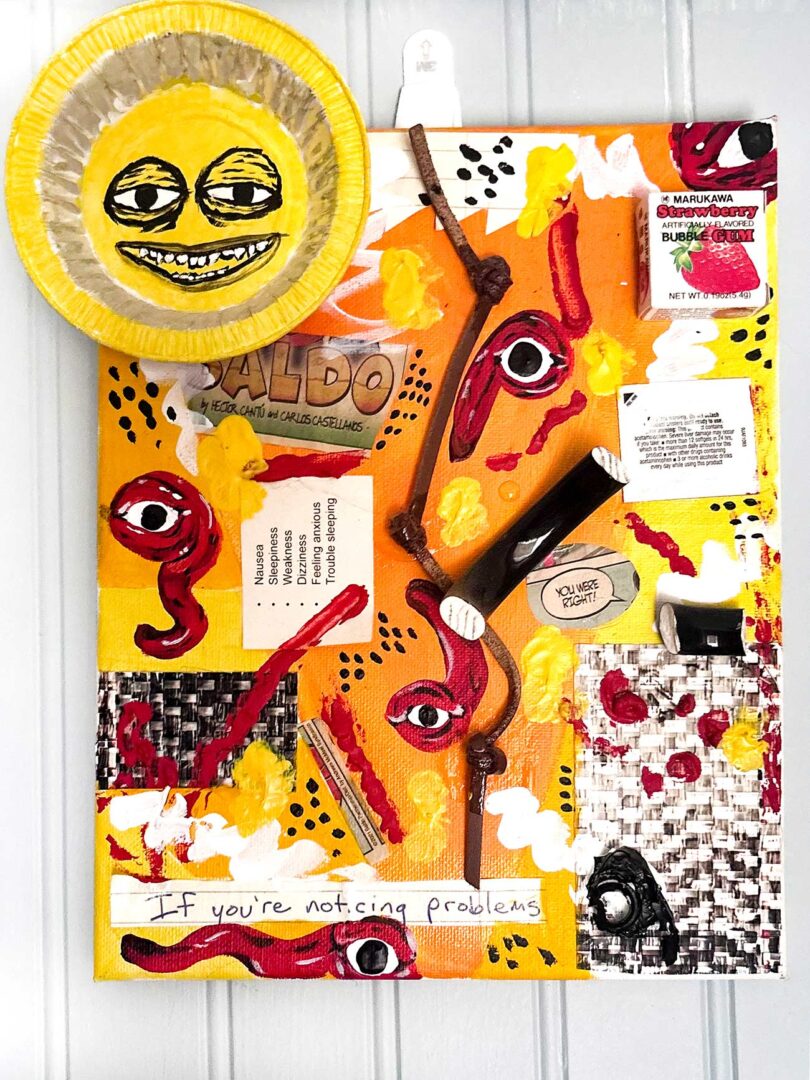
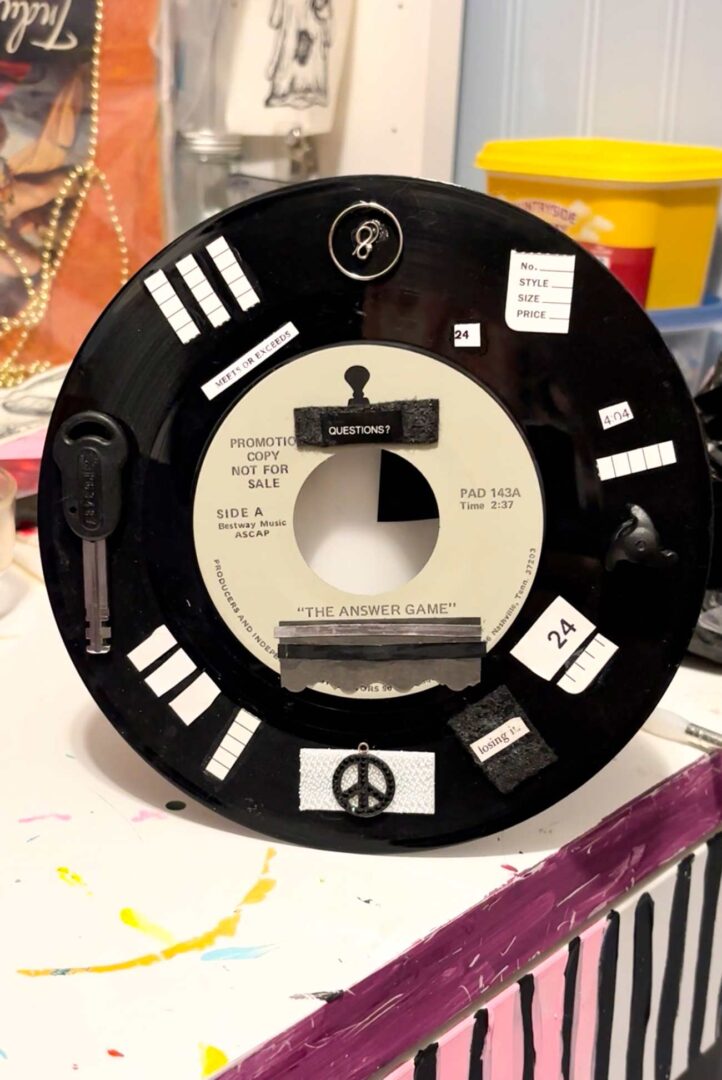
Marshall has been creating art their entire life, but they say noticing all of the odds and ends strewn around the streets of Minneapolis inspired them to build on their existing abstract painting practice. The result: three-dimensional compendia of bits and bobs whose individual details contribute to larger visual narratives, each one different from the last. One piece is an LP with pieces of text and a car key stuck to it; another has a pie tin painted yellow, leering at the viewer from the upper left corner of a canvas covered in painted eyeballs.
The pieces call to mind the scrappy nature of the Minneapolis youth and punk scenes, as well as the inherent environmental messaging of cleaning up litter. Marshall also describes the repurposing of found objects as an expression of their queer identity.
“It’s nice to be able to take something that society sees as trash and turn it into a beautiful piece of art,” they say. “I think that’s how a big chunk of society views queer people. (They) wouldn’t give us the time of day, but really, everyone is their own piece of art.”
This year will be Marshall’s fourth Art-a-Whirl and third in the Northeast Tree House, a fitting setting to display their playful portfolio. Besides their eclectic artwork, another draw to Marshall’s space will be their communal Junk Jar. Anything you have in your pockets that you can part with, Marshall will take and make art with.
“When people have visited me and my art, I get some pretty cool stuff from them,” they say. “Everyone has a little piece of trash, and that trash can become art.”
Third-Eye Girl — 2010 Artblok
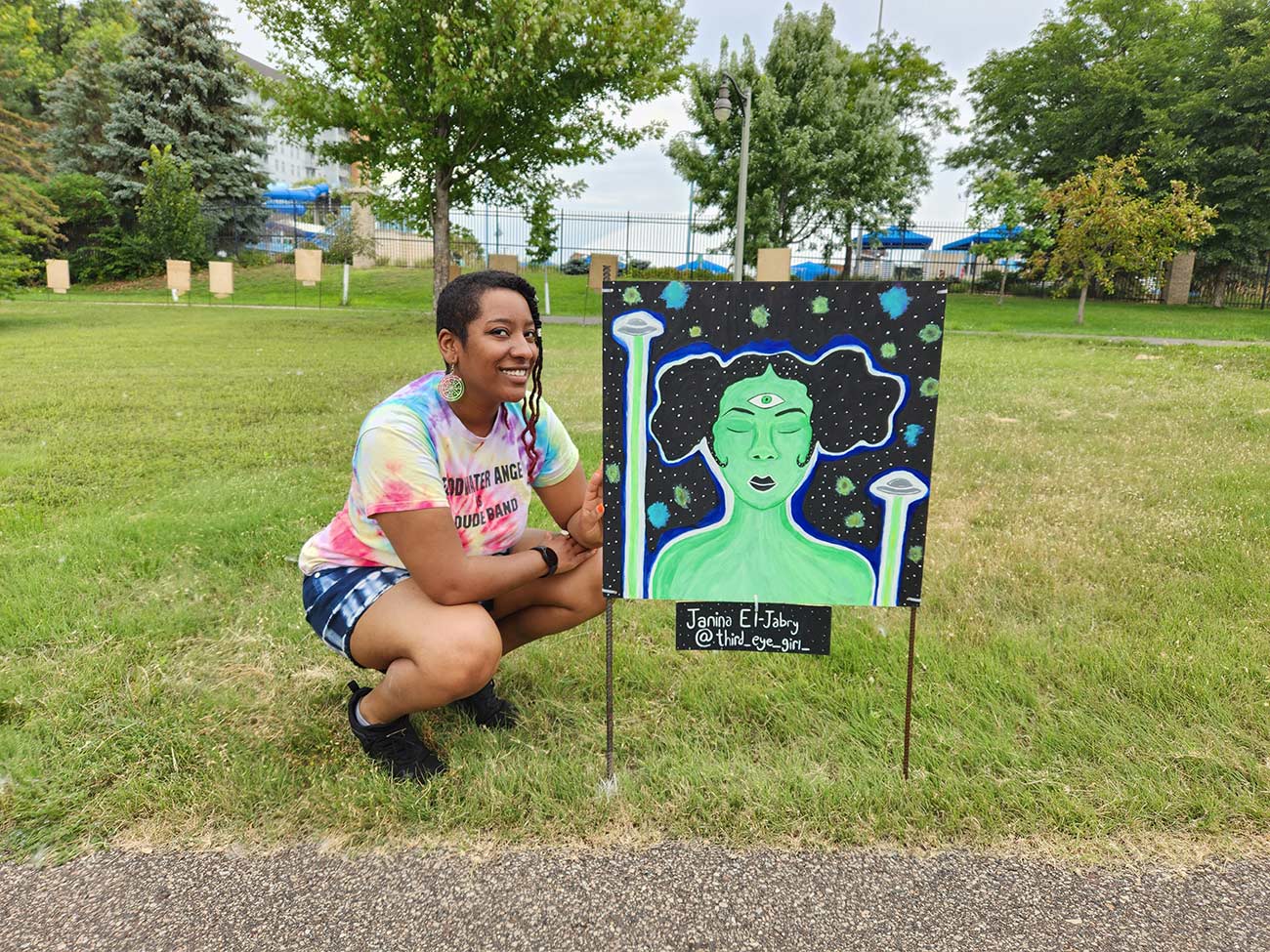
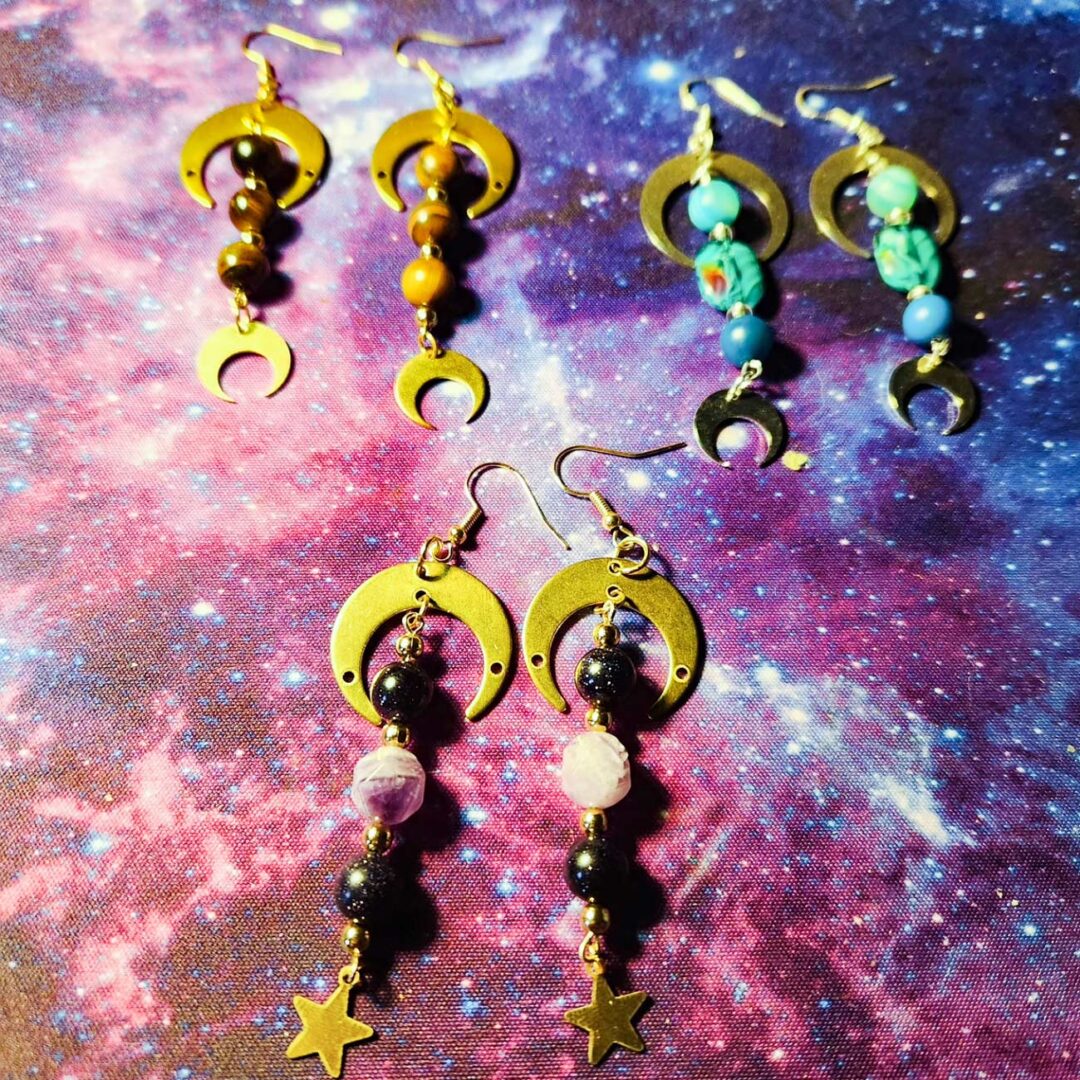
A self-described jack-of-all-trades, when Nina El-Jabry, aka Third-Eye Girl, takes an interest in a new creative pursuit, she follows it through. And those pursuits are many, from painting to drumming to jewelry-making to crafting whipped body butters to DJing to blogging about and organizing BIPOC-centered music events in the Twin Cities.
“I kind of just always create,” she says. “There are ideas that go through my mind all the time, kind of like this stream of consciousness that keeps flowing, and that excites me and fuels me.”
The hippie implications are strong with a pseudonym like Third-Eye Girl, but El-Jabry explains that she interprets the third eye symbol more holistically to avoid the “good vibes only” sentiment many bring to it.
“Using your third eye, you are looking at things objectively. And I find that very important because it’s kind of like a way to see the balance,” she explains. “You see the good in life and the bad, and then it’s our job to find that balance between the good and the bad.”
It’s an apt symbol for someone balancing so many creative endeavors. Lately, El-Jabry has been focusing on her blog, Twin Cities BIPOC Music, and organizing related events.
El-Jabry says she got the idea for the blog while working at a music nonprofit that claimed to be intersectional, but didn’t push for diversity beyond white queer folks.
“I feel like Minnesota in general feels like if there’s a space where it’s white and queer folks, that’s good enough diversity, which doesn’t cut it for me personally on my moral compass,” she says. “I mean, I love that there’s some diversity, don’t get me wrong. If there’s any diversity in a space, that’s better than nothing. But I ended up realizing that there needed to be more of a space where we could specifically appreciate BIPOC musicians.”
It’s a project she’s spearheaded since the summer of 2023, and it eventually led her to connect with her favorite blog, Punk Black, and organize an event with them at Underground Music Cafe in Minneapolis.
“I just internally screamed,” she recalls. “I’ve already hit a few milestones that I’m forever grateful for.”
An Art-a-Whirl veteran several times over, this year will be El-Jabry’s first in her studio at 2010 Artblok, part of a former General Mills plant located on the edge between Northeast and Southeast Como. She describes her studio as an out-of-this-world oasis in the middle of a concrete maze.
“We have a nebula space mural, and there’s also twinkly lights above it,” she says. “I have my lime green acoustic drum set right there, too, and I have cute little kawaii items all around. It’s really pretty and gorgeous. You have to go in and see it for yourself.”
El-Jabry says her favorite part of Art-a-Whirl is the buzz that electrifies the entire neighborhood.
“I’m a connector, so I love connecting with people,” she says. “I really love the connection process of the art world, because that’s really what it is. Not only are you just there to sell art and have art be available, but you’re connecting with people that want to know about your art.”
So come step into Third-Eye Girl’s world this Art-a-Whirl (don’t let the projected eye on the door scare you!)
El-Jabry also has a message for Lavender readers: “Your dreams are not impossible. Just remember to take your time. Great things take time. Just be patient and do what you love.”
Rubenstein Studio — California Building, Studio 207B
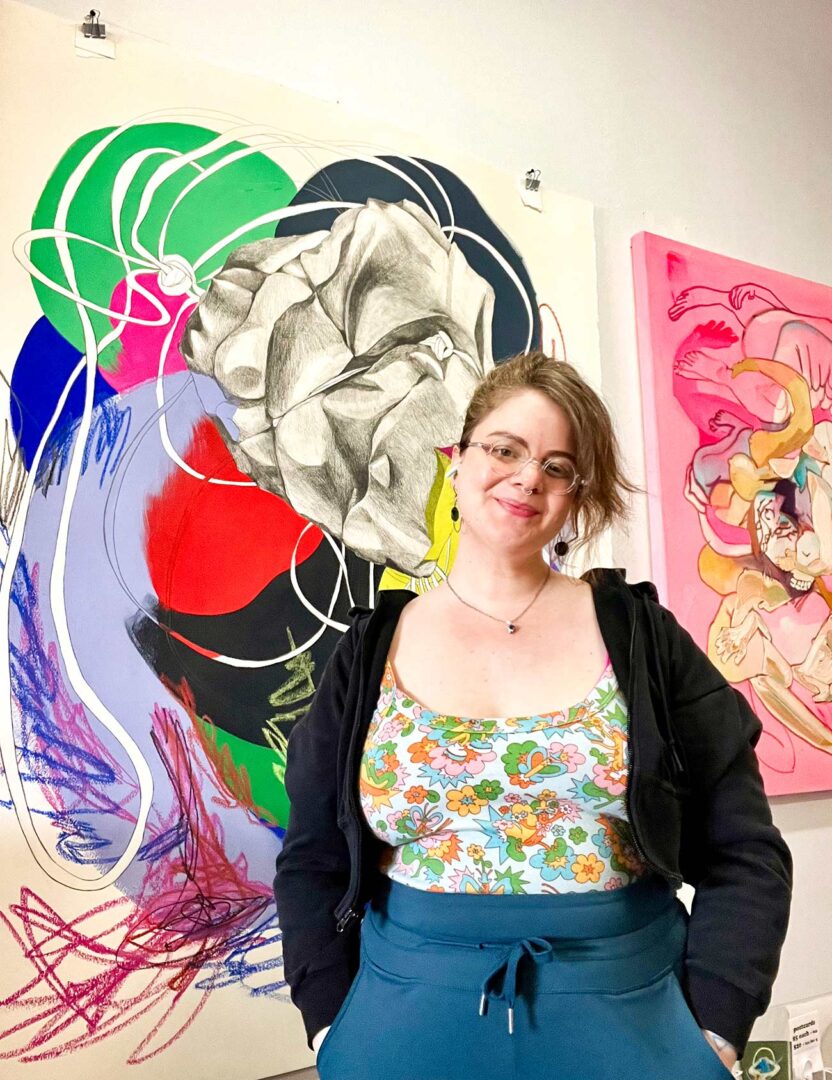
Like many kids, Madison Rubenstein loved drawing and painting. However, art took on a new meaning for them when they became chronically ill at a very young age.
“Art felt like a way for me to express what I was experiencing because what I was experiencing, I couldn’t really find the words for,” Rubenstein, now 35, says. “It became a language for an internal landscape. I think my parents noticed that, and I was very fortunate that they kind of nourished that with me.”
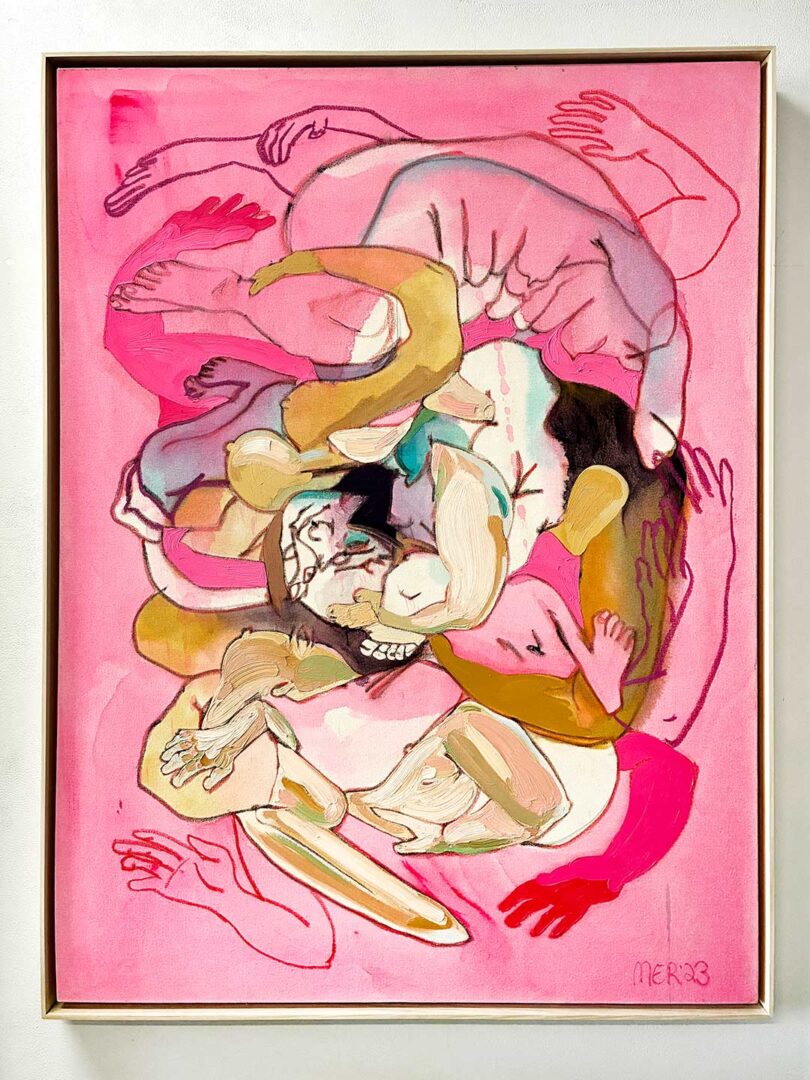
Today, Rubenstein has a studio in the California Building, where their experience as a queer disabled person is centered in their artwork. In fact, they say making art is what helps them survive as a disabled person.
“Being queer and disabled means that I’ve received this constant messaging from the world that I don’t belong or that I should be different, and those ‘shoulds’ don’t exist in art making,” they say. “I kind of get the opportunity to invent something that didn’t exist before.”
Rubenstein’s work primarily does this through abstract bodily forms — headless and limbless torsos, for example — that fluidly defy logic and occupy imagined spaces.
They also mention how being a professional artist helps them accommodate their chronic illness flare-ups because they can make their own hours.
This year will be Rubenstein’s 12th Art-a-Whirl, and they’ve participated since graduating from the Minneapolis College of Art and Design.
“I feel very lucky,” they say. “My studio is my favorite place to be, and I love being able to talk to people about what I do.”
Community is another dimension of Rubenstein’s practice, as they believe creativity comes from the same part of our brains that helps us imagine new realities and better futures for ourselves.
“We are wired to feel a sense of safety in what’s familiar, and the context of art making is a safe place to practice challenging those fears and anxieties,” they explain. “I feel like that’s the same part of our brain that we need to imagine collective liberation.”
Indeed, alongside paintings and prints of their abstract work, Rubenstein also produces stickers and apparel featuring line drawings of garlic, poppies and anise hyssop with the phrase “Your survival and mine are intertwined.”
Rubenstein makes it a point to offer artwork that’s priced accessibly for everyone. Paintings priced in the hundreds of dollars — for which they offer payment plans — can be bought as archival prints starting at $25. They also sell their work in sticker form in the $4-$5 range.
“I want the people that really resonate with my work to have some,” they say. “Especially with the times that we’re in now, there are fewer of us buying homes, fewer of us able to make what are regarded as luxury purchases.”
Rubenstein, who is originally from Los Angeles, says they didn’t see themself staying in Minneapolis until a few years ago. They say the artistic community that has emerged not just in their building but in Minneapolis at large has been a major draw to stay, as well as how much funding the arts get in Minnesota.
“I have friends on the East Coast who are also working artists, and they have a much harder time getting support and funding than people here do,” they say. “I realized, actually, this is a good place to be. And I’m okay with being surrounded by all these amazing and talented people.”
While it’s likely impossible to see everything at Art-a-Whirl, these queer artists are emblematic of the strong, vibrant arts community in Minneapolis. Even if you just visit them, it’ll be enough to keep you coming back.
More information about this year’s Art-a-Whirl is available online at nemaa.org/art-a-whirl/.



5200 Willson Road, Suite 316 • Edina, MN 55424
©2026 Lavender Media, Inc.
PICKUP AT ONE OF OUR DISTRIBUTION SITES IS LIMITED TO ONE COPY PER PERSON