


Eleanor Lerman Confronts the Passage of Time and Grief In ‘Oleander Marriage’
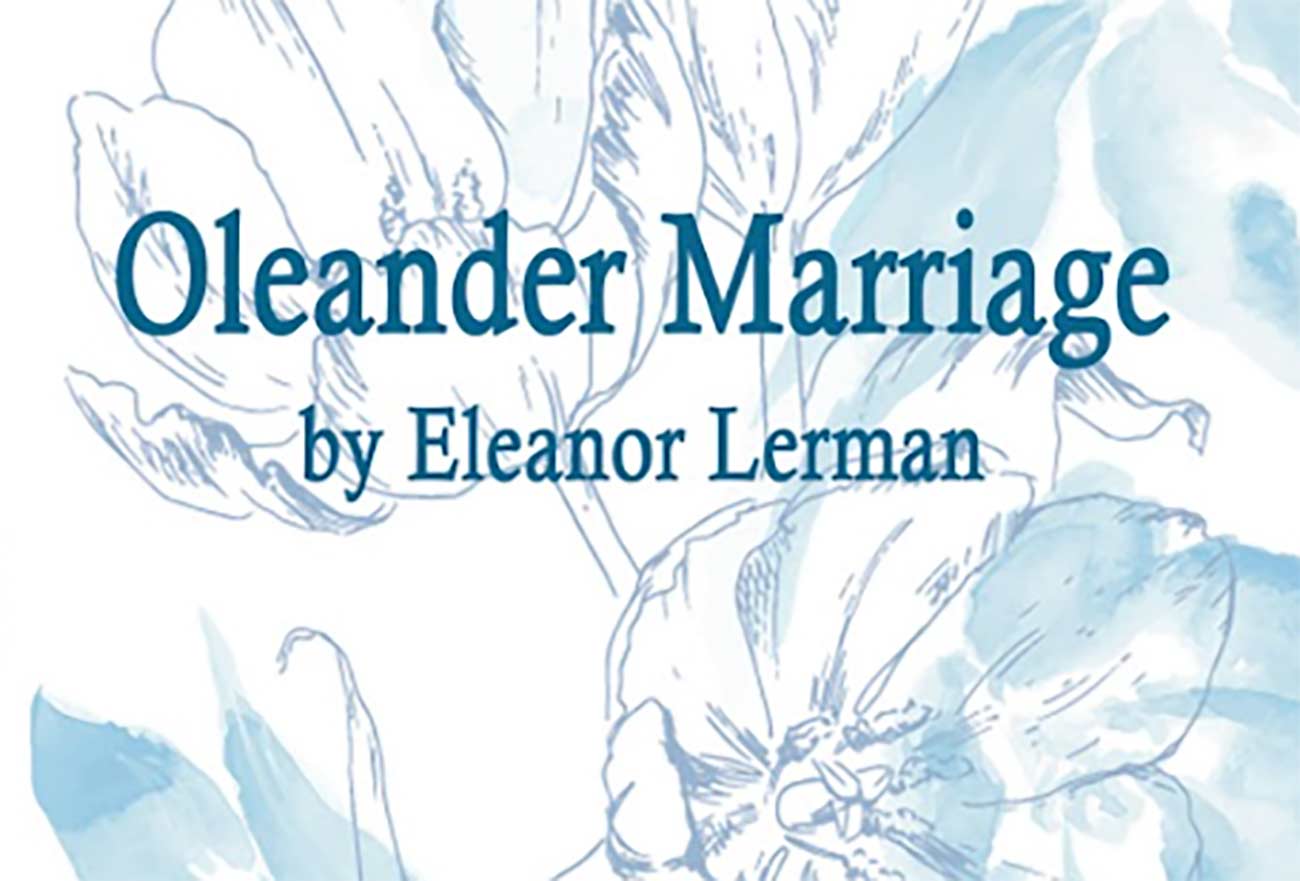
All it took for Eleanor Lerman’s life to change was one book. At 15 years old, Lerman was living in a beachy Queens, New York City neighborhood called Rockaway. One day, she decided to take a trip into town. She ended up in a drugstore where she idly walked about before noticing some books for sale.
“I had gone into the town to a drugstore, and there was a rack of books in the front of the store. I was just biding my time, and I was looking through the books, and there was a book called ‘The Spice-Box of Earth’ by Leonard Cohen. … I knew him as a songwriter and singing on the radio, I didn’t know he was a writer,” Lerman says. “So, I got on the bus home, and I read this book. By the time I had gotten home 20 minutes later, my life had changed, because I knew what I was going to be. I was going to write, write seriously, and I knew how I was going to write, because I had finally found the key to poetry.”
This hadn’t been Lerman’s first exposure to poetry, but it had been the first time she truly understood it. Up until this point, her background in poetry was only what was taught to her in school. There she had learned the more traditional works of the famous writers before her, written in styles that she couldn’t fully understand. It was through reading Cohen’s style of writing that she unraveled the way in which a poem works. And, once she figured this out, she knew she was going to be a poet.
“When I was in school, the kind of poetry they read us … I didn’t understand any of that,” Lerman says. “But Leonard Cohen was writing in real language. You know, simple, beautiful, rhythmic language; I understood it, I knew I could do it, and from then on, I was very serious about it.”
Only three years later, at 18, Lerman found herself managing a business that manufactured parts for harpsichords. At work, she would write poems on a blackboard that was intended to be used for writing what parts were needed. A neighbor, who had been passing through their building to get his mail, eventually asked who was responsible for the poetry. Lerman let him know the work was hers. He told her that he enjoyed it, and he really thought she should get it published.
“I had never thought of doing that. So, I … had all these poems in a folder, and I sent them to, I think, Leonard Cohen’s publisher, who wrote me back and said, ‘Well, Eleanor, we don’t really publish any poets besides him, but this is really great work. I think you should send it to Wesleyan University Press,’ which I did,” Lerman says. “And, they published my first book. That’s how it all began, and that first book was a finalist for the National Book Award. I was one of the youngest people nominated for that. It got me into a famous literary feud with three women writers.”
The feud, Lerman described, involved a misunderstanding between other contenders for the prize. Lerman had found herself being misunderstood when she was telephoned by three different women asking her to join a protest. Lerman recalls responding to Adrienne Rich, another famous lesbian poet, with her perspective.
“I had said to Adrienne … ‘We are the feminist movement. Look at me. I’m 18, I’m living alone, I’m supporting myself. You know, my problem is not men. My problem is that poets don’t make money,’” Lerman says. “So, they all got very mad at me. … So, this is all to say, when I was younger, there was a whole big deal. I had my 15 minutes of fame. But then things quieted down as they always do. … Since then, I’ve written novels and collections of short stories and several books of poetry.”
Despite a short break that Lerman described as “nothing to do with anything,” she has persistently written in different forms and styles throughout the years. Her moment of fame never interfered with her writing, and she has continuously brought out new material. In her latest release, a poetry collection titled “Oleander Marriage,” Lerman’s history and present fuse together through each poem to create a connected tale of grief, love and memory; highlighting how she has emotionally revisited her past and what it has revealed to her.
“I think I’m a very sort of workman-like writer. When I finish something, I usually have an idea where I’m going to finish one book; I usually have an idea that I’m going to start another,” Lerman says. “And, while I was writing whatever came before this, … I had been collecting ideas for what I was going to write next. And, I actually think this book was written last summer. And, I just sat down, and I wrote them one after another, so they are connected.”
Growing up, Lerman and her brother tragically lost their mother at a young age. Very soon after, their father remarried, and they were introduced to their stepsister, who had untreated schizophrenia. This experience led to Lerman and her brother leaning on one another for support as they grew older and confronted their childhoods. Lerman sectioned the book into two parts. The first part centers both her reflections on this time in their life.
“The first section of the book is born from those endless conversations with my brother about my mother, our mother, and you know, the grief and the pain and all the things that happened to us when she died,” Lerman says. “This woman that we lost that we don’t even remember … because after she died, my father essentially said to us, ‘She died, here’s the new mommy, let’s get on with life.’”
As described, Lerman’s first section of the book is heavy with emotion. Each poem spills into the next, flowing from vignette to vignette. Lerman’s use of figurative language delicately captures the complexities of emotions and how they evolve throughout time, something her brother noted upon reading this collection.
“He also said to me that … ‘This is the first thing you’ve written, I think, where hope is not what I feel when I finish this,’” Lerman says. “He said, ‘I really feel the weight of grief and time.’ And, I said that’s probably what’s here.”
The second half of the book pulls from Lerman’s more recent life as she writes about the memories and experiences she has gained through her marriage. These poems, while lighter than the first section, do not pull away from the bittersweet emotions that come upon rumination of a life well lived.
“The other person the book is dedicated to is Robin. And, so it’s about, you know, the wonderful parts, and also the very difficult parts of a long marriage,” Lerman says. “We’ve lived with each other since I was 49-50; she’s 10 years younger than me. So, we’ve gone through a great deal in all that time.”
While the book is sectioned into parts, Lerman makes it clear that the poems are all connected through the way time warps and changes memory and emotion. This connection is pronounced through the fluidity of the poems, where bits of imagery appear and reappear throughout the collection.
As the reader follows along, they are met with many different stories. One poem may share a vignette of a warm summer day spent mulling over art, the next, a resignation at having to come to terms with the passage of time. Overall, Lerman’s collection evokes the feelings of inner conflict one faces when they confront their life as a whole.
Eleanor Lerman’s latest work, “Oleander Marriage,” revisits her career, her family and her memory as she reflects on her life. As each poem invites the reader to slip into the next, the reader is confronted with the joys and losses of beauty and pain. To purchase her book or learn more about her, please visit eleanorlerman.com.




5200 Willson Road, Suite 316 • Edina, MN 55424
©2026 Lavender Media, Inc.
PICKUP AT ONE OF OUR DISTRIBUTION SITES IS LIMITED TO ONE COPY PER PERSON