


Creating a More Accessible Queer Community with Queer ASL
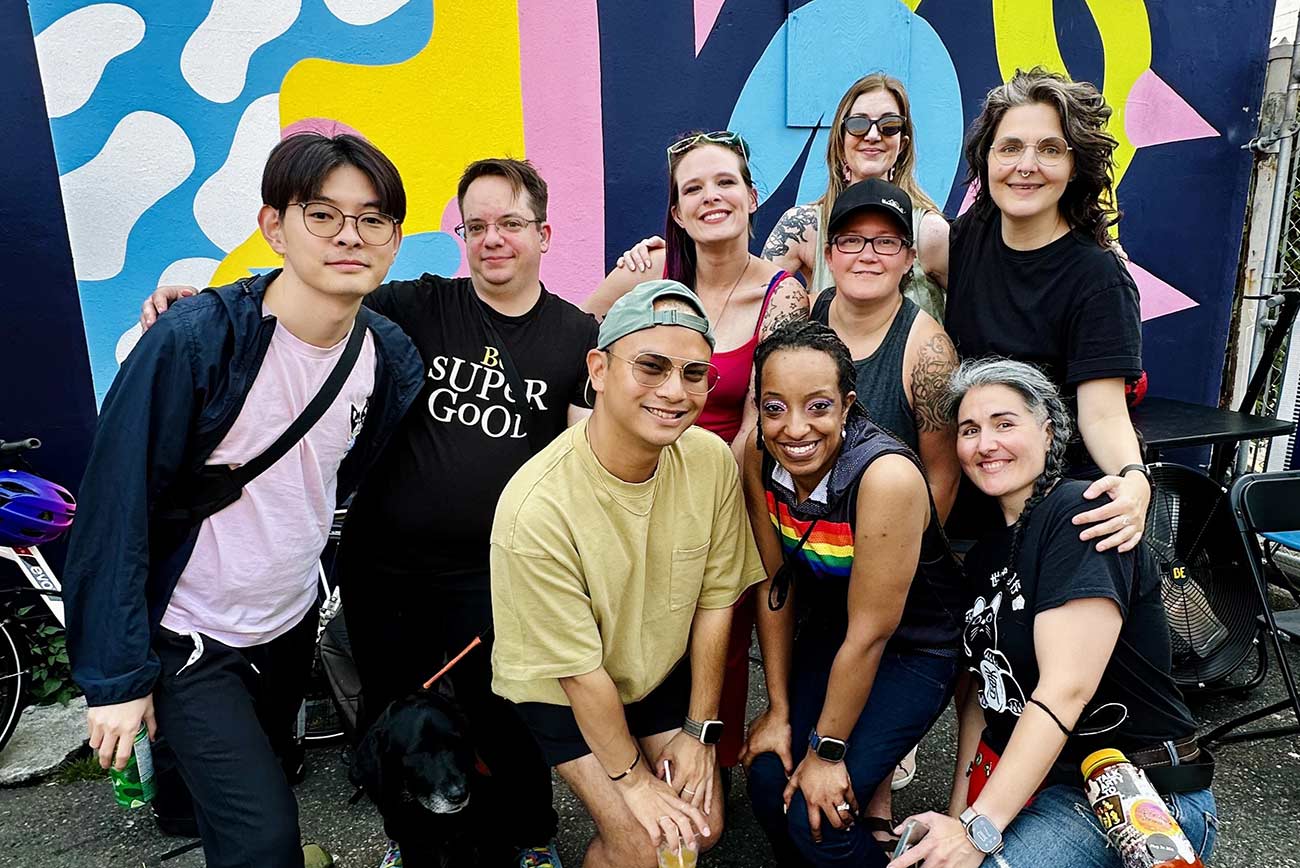
The Vancouver, British Columbia-based organization has been teaching American Sign Language to queer and trans folks and their allies since 2011. Now fully online, Twin Cities learners can join in, too.
Zoée Montpetit describes growing up Deaf as feeling both hypervisible and invisible at all times.
“I was very visible as the only Deaf student, but at the same time invisible as basically nobody knew how to communicate with me,” they say.
While Montpetit says they’re comfortable communicating in written English, exploring the Victoria, British Columbia, queer community was difficult as a non-speaking Deaf person with no lip-reading abilities.
They needed a way to bridge the gap between them and their queer hearing friends, so in 2009, they started hosting meet-ups in their living room where they would teach their friends American Sign Language.
“We were able to ditch the paper and pen within months,” Montpetit says.
That club was the seed that would later bloom into Queer ASL.
“I learned how powerful it was to share space together,” Montpetit, now 44, says. “After moving to Vancouver, I decided that instead of setting up a casual club again, I would develop and teach branded classes and the rest is history.”
What sets Queer ASL apart from other ASL programs is its explicit centering of queer and trans learners and their allies. Not only are all Queer ASL teachers queer Deaf people; their curriculum is “a celebration of our lives as queers and trans people,” according to Montpetit.
Accessibility is Queer ASL’s modus operandi. Along with their general courses, which anyone can join, Queer ASL also offers classes for QTBIPOC learners taught by QTBIPOC Deaf teachers. There are also classes designed for people with disabilities that accommodate difficulties with eye contact, limb differences and so forth.
“I very strongly believe in the power of being in a space with folks like yourself,” Montpetit says. “Our general classes also focus on accommodating everyone’s access needs, but let’s be real, it’s always extra magical to share space with people like yourself.”
Nearly a decade after Queer ASL began in earnest, the COVID-19 pandemic arrived in Vancouver, halting the in-person classes that took place across the city. While it pushed classes online, Montpetit says it was for the best.
“Online classes are really cool because we can interact with people all around the world and it’s much more accessible for some people,” they say.
They say it also allowed them to implement a flipped classroom format, meaning learners watch lesson videos beforehand and can then focus more on reviewing, clarifying and practicing in class. Montpetit says it supports memory retention and helps learners stay engaged with class content throughout the week.

It also means interested learners in the Twin Cities can sign up, too.
Erin Mullen of Minneapolis is an incoming graduate student in speech language pathology at the University of Minnesota Duluth and took four semesters of ASL classes in undergrad. They say learning ASL broadened their perspective on the world and the possibilities of communication.
“You never know when you’ll interact with someone who is deaf or hard of hearing,” they say.
They share an anecdote about running into a man who signed while he spoke, saying that his face lit up when they started to sign back.
“Lipreading can be so exhausting, and he was just so excited that I could sign with him,” they say. “I would like to see a world where people can go about their day and not feel like they’re going to be misunderstood.”
Mullen says they’re very interested in Queer ASL as a queer person who wants to keep interacting with the deaf community.
“It sounds like a great organization,” they say.
Montpetit says the best part about teaching ASL is “seeing the moment where [learners] start believing in themselves and their ability to express themselves through ASL no matter how much of a beginner they are.”
Monpetit no longer teaches, instead focusing on overall operations and developing a massive new curriculum they hope to launch next year.
Queer ASL classes operate in cycles, with classes opening for registration five times a year, typically January, April, June, August and October.
Additionally, classes are offered at sliding scale pricing. Those who can’t afford the price range are placed on a waitlist with a chance of being placed for free if someone drops out.
“The world constantly punishes people living in poverty and I don’t want Queer ASL to be yet another thing that is inaccessible because of our cost,” Montpetit says.
At the same time, they say Queer ASL is constantly navigating how to balance accessibility with funding and paying its teachers fairly as a 100% Deaf-run small business.
So why should hearing queer folks learn ASL? Montpetit says the queer and Deaf experiences overlap more than some might think.
“Queer people often are born into families that are mostly straight and this is very much the same for deaf people who are born into families that are mostly hearing,” they say. “Queer and Deaf people have to navigate their, at times painful, experiences of growing up, figuring out their identities, and finding their place in the world. Over time, though, we all discover a community full of people like us and develop a fierce love for who we are.
“The more aware you become, the more you notice how queer events need to become more accessible so deaf queers will actually want to (and can) show up.”
Those interested can sign up for the Queer ASL mailing list on their website and follow them on Instagram and Facebook, @queerasl.
Zoée Monpetit responded to interview questions via email. Their answers have been edited for brevity and clarity.
Info on the capitalization of Deaf: https://ncdj.org/style-guide/#D



5200 Willson Road, Suite 316 • Edina, MN 55424
©2026 Lavender Media, Inc.
PICKUP AT ONE OF OUR DISTRIBUTION SITES IS LIMITED TO ONE COPY PER PERSON