


‘A Rare Kind of Space’
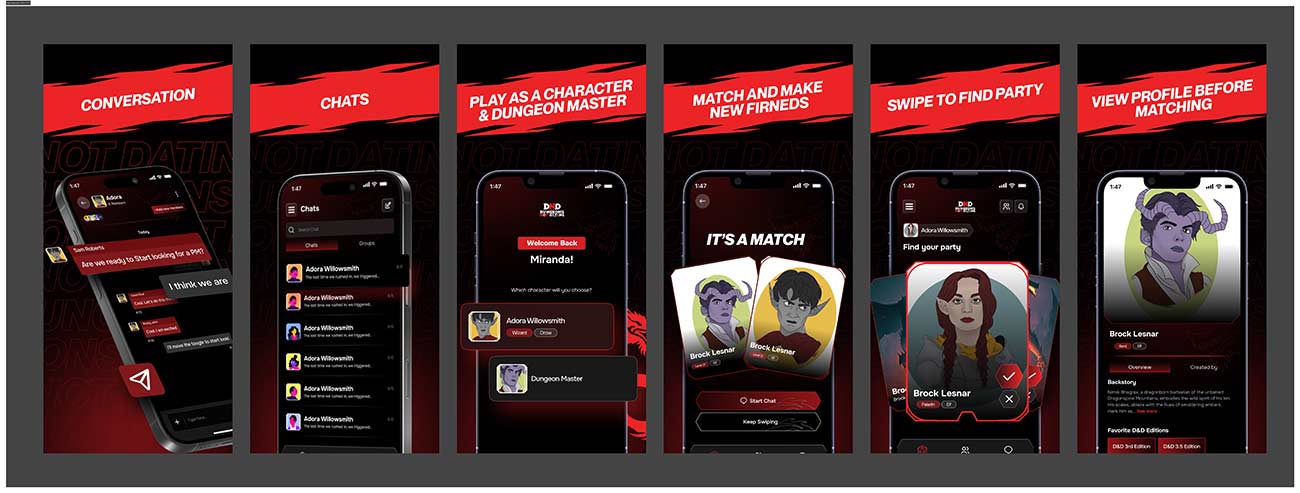
Gamer Rachel Dove introduces an app that unites fighters, not lovers
Repulsive, hirsute, green-skinned, pig-snouted assassin of half-human, half-orc stock, drug and mostly disease free, seeks a partner in life and murder. The winning candidate will be proficient in the wielding of poisons, daggers and poisoned daggers. Gnomes, halflings and especially elves need not apply. Responses that include self-portrait woodcuts will receive fastest reply. Let’s see how well your sheath matches my blade!
Something similar to the above might be evoked when first hearing of Dungeons Not Dating. DND is a smart device mobile application (or, as the digital wizards call it, “an app”) which, not unlike a lovelorn killah’s online profile, might require a squint or three for proper evaluation.
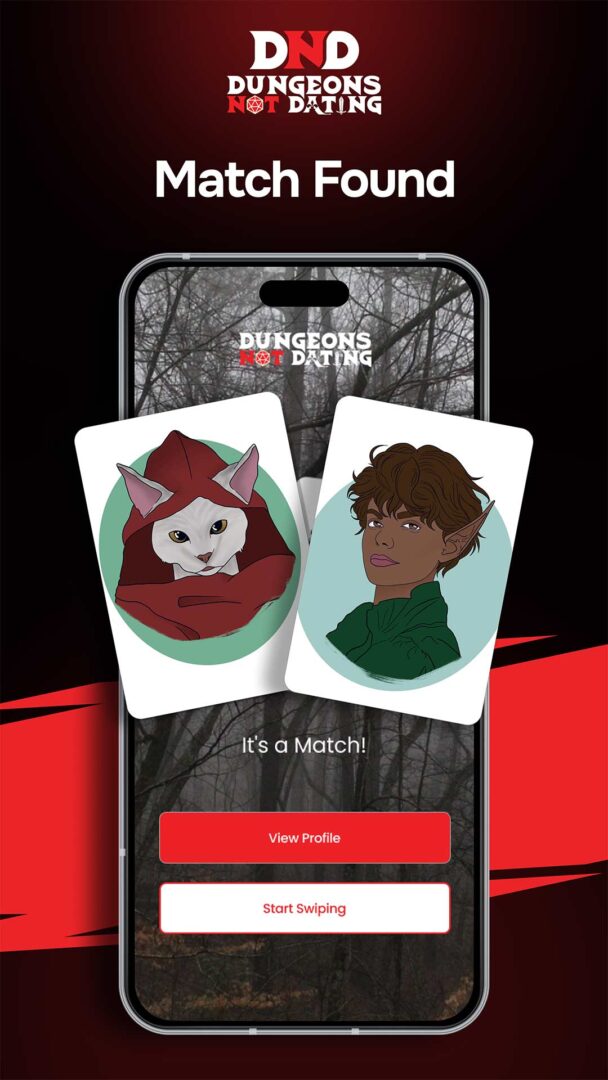
“The name ‘Not Dating’ is often misunderstood,” admits Rachel Dove, the app’s creator. “The app is structured like a dating app, with profiles, swiping and matching, but the goal isn’t romance. It’s to build a compatible adventuring party.”
The adventuring — and the partying for that matter — takes place mostly within the right brains of the adventurers: that is, the players of “Dungeons & Dragons,” the venerable dice-throwing game wherein participants assume Tolkien-esque selves as they engage in an experience that’s half probability, half possibility.
But sometimes, D&D companions can be as rare as gold pieces in the elemental plane of fire.
“For a lot of players — especially new, marginalized or queer players — finding a safe, consistent group is the hardest part of playing ‘Dungeons & Dragons,’” Dove observes. “Existing tools are fragmented, local or intimidating.”
That’s where Dove’s software unites prospective fellows-well-met who share overlapping game preferences.
“You’re matching on experience level, values, availability and playstyle, which is how someone prefers to experience the game: story-focused versus combat-heavy, serious versus lighthearted tone or rules-focused versus flexible,” Dove explains. “Instead of dating, you’re forming a campaign and ideally, real friendships.”
The campaign — that is, the long-term, ongoing story constructed via multiple adventures — might be built physically or virtually.
“Gameplay can look different depending on the group,” Dove elaborates. “Some play in person around a table, virtually using video and digital tools, or a mix of both. One of the long-term benefits [of DND] is helping more players transition from isolated or online play into consistent, real-world groups if that’s what they want.”
Getting to this point represents a victory of sorts.
“Gamers are often stereotyped as socially awkward, isolated or part of a very narrow demographic.” Dove laments. “But the reality is much broader. The tabletop space today is incredibly diverse across gender, sexuality and background.”
And those aren’t the only benefits tabletop play might provide.
“Tabletop role-playing games like ‘Dungeons & Dragons’ create a rare kind of space where identity is fluid, intentional and respected,” Dove points out. “For queer players — especially those without safe offline environments — it can be a powerful way to explore identity, be seen as your authentic self and practice expressing that identity in a supportive group.”
The diversity of play might be a side effect of the diversity of content.
“Over time, the game itself has become more accessible and inclusive, with broader representation in both players and characters,” Dove notes. “When people can find others like them, they’re more likely to stay and thrive in the hobby.”
That broader representation is what attracted Dove.
“I started playing ‘Dungeons & Dragons’ as an adult, initially drawn in by the storytelling and creativity,” she recalls. “It’s one of the few games where collaboration matters more than competition.”
That lack of competition can leave room for emotional growth. As Dove testifies: “I personally used D&D to explore my own gender identity, playing male or nonbinary characters to see if that fit who I was in a safe and consequence-free area of life before coming to the conclusion that I am just an old-fashioned tomboy.”
Such emotional growth is something that, unlike a magic spell or a 20-sided die or even a poisoned dagger, Rachel Dove can wield in the real world just as surely as she wields it within the game’s collective surreality.
“[Playing D&D has] made me more confident, both creatively and socially,” she affirms. “It gave me a space to take risks, use my voice and build community. It’s not just escapism. It’s often exploration and affirmation.”




5200 Willson Road, Suite 316 • Edina, MN 55424
©2026 Lavender Media, Inc.
PICKUP AT ONE OF OUR DISTRIBUTION SITES IS LIMITED TO ONE COPY PER PERSON