




‘Twins and Needles’ – Activist Sue Westegaard Proves A Stitch in Time Saves Lives
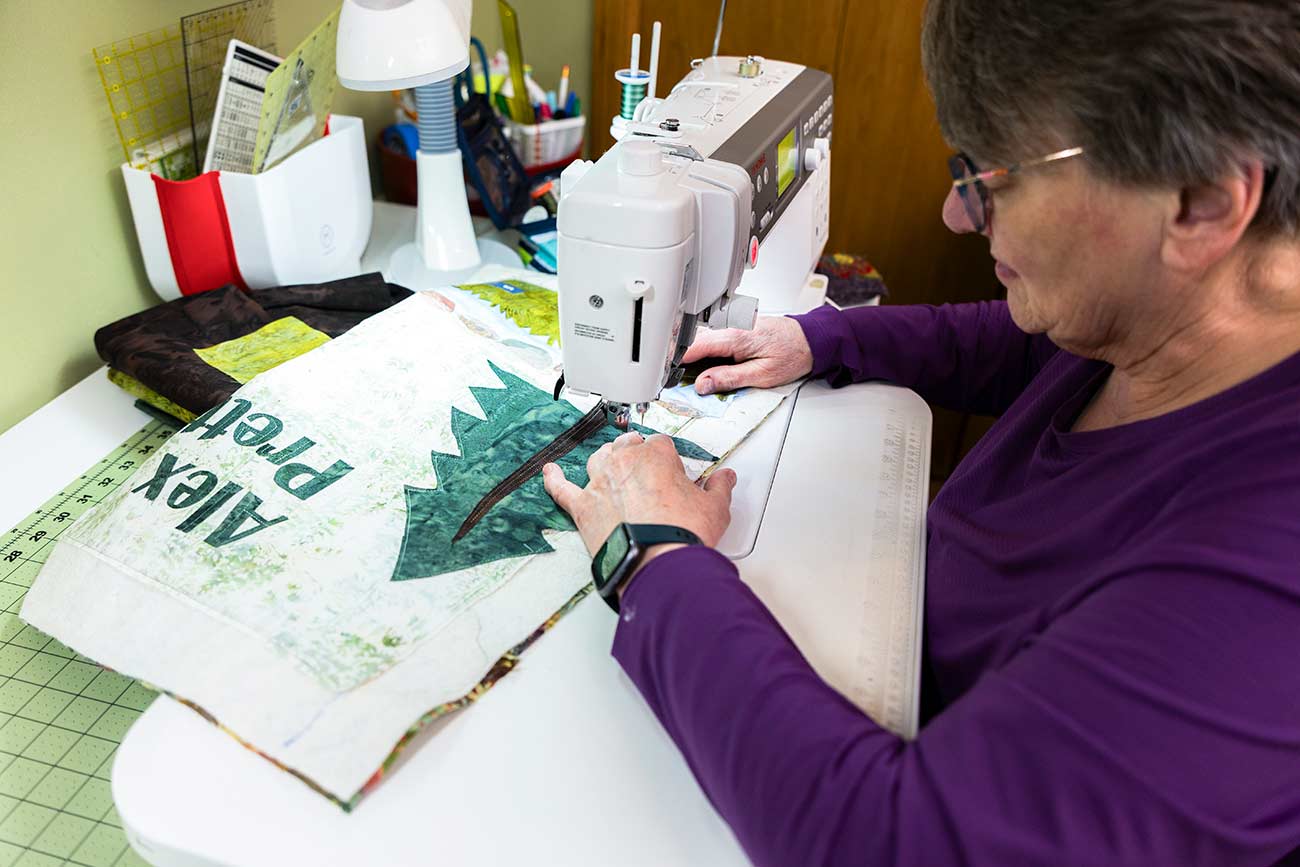
Even the descriptor “LGBTQ+” makes the point: the queer community sees itself as a quilt of sorts, a patchwork of castaways stitched together with a thread that’s hard to define. The “castaway” part was especially easy to identify with, not that many decades ago, when quilts took on a special significance for the rainbow tribe in a big way.
During the 1980s, the unchecked HIV/AIDS virus tore through the “gay community,” as it was known then, leaving in its merciless wake countless tragedies of lives needlessly ended too soon. Because of the stigma associated with the new and terrifying disease, many of these dead were not even given funerals.
In order to right this wrong, in 1985, activist Cleve Jones conceived the NAMES Project AIDS Memorial Quilt, finally bringing it to life in 1987. In doing so, Mister Jones bequeathed overdue appellations to nearly 2,000 anonymous HIV/AIDS victims, forever linking the queer community to this particular form of commemoration.
During this same era, Minneapolis’s Aliveness Project came to be. Its original purpose was to prevent as many new names as possible from adhering to that quilt. This was achieved, at least at first, by building a shame-free community using that most Minnesotan of traditions, the potluck.
Today, according to its website, the Aliveness Project “supports people living with and at the greatest risk of HIV through transformative resources and direct services.” These services include housing help, HIV testing and support groups, among others.
Dylan Boyer, the Aliveness Project’s current director of development, brought the notion of commemorative quilts to a pair of recent local demises that, although much smaller in scale when compared to those of the Me Decade, were no less tragic: the much-publicized deaths of Renée Good and Alex Pretti. When Boyer considered remembering the two Minneapolitans quiltatiously, he knew just where to turn.
“I have volunteered to help with registration for the Red Undie Run,” says Sue Westegaard, recalling the Aliveness Project’s light-hearted observance of World AIDS Day, where participants traverse one nipple-hardening mile wearing little more than passion-colored unmentionables.
It wasn’t, however, Westegaard’s skill as a registrar that Boyer had in mind — it was a more creative ability that ran three generations deep.
“My grandmother and mother quilted,” Westegaard reminisces. “Mom asked me to draft a block of a certain size and a certain pattern.”
Before being approached by Boyer, Westegaard was already experienced at combining her art form with unlikely ideas. A teacher by trade, Westegaard’s family tradition provided literal material for her day job.
“I presented many sessions on the mathematics in quilting at state and national mathematics conventions and wrote several articles for [the National Council of Teachers of Mathematics] publications,” she reports. “Over the last 20 years, I have done traditional quilting, as well as paper piecing.”
So the suggestion for a quilt remembering Renée Good and a quilt remembering Alex Pretti was made … but a thoughtful, heartful pause followed.
“When Dylan and I talked about doing wall hangings for the Good and Pretti families, the idea of doing an ‘art quilt’ was daunting,” Westegaard confesses. “I wanted each wall hanging to represent the way that Renee and Alex lived, not how they died.”
This commitment to aliveness guaranteed Westegaard’s approach would not be stitch first and ask questions later. As she describes: “On the back of each hanging was a letter explaining why I chose each item on hanging.”
In other words, Westegaard understood that these hangings weren’t just stitching sashings to blocks — these hangings were the stories of human lives.
Toward the end of achieving this laudable goal, Westegaard engaged in an art form even quainter than quilting — she listened.
“I listened to Renée’s brothers’ testimony before the Senate and read her wife’s message on Facebook,” she says.
She naturally brought the same approach to her second subject. States Westegaard, “When I started on Alex’s, I watched some YouTube videos — one of him leading a ceremony for a veteran who had died and another by a person who had been his patient.”
This sense of literal connection defines the quilts commemorating Renée Good and Alex Pretti … and the quilt that is the LGBTQ+ community. Thanks to the efforts of Westegaard and the Aliveness Project, the threads that bind its castaways together aren’t hard to define, after all — those threads are love.
The Good and Pretti quilts can, for the time being, be seen at the Aliveness Project’s office.


5200 Willson Road, Suite 316 • Edina, MN 55424
©2026 Lavender Media, Inc.
PICKUP AT ONE OF OUR DISTRIBUTION SITES IS LIMITED TO ONE COPY PER PERSON