


‘We are Everywhere, Doing Everything’
“Queering Indigeneity,” the latest exhibit at the Minnesota Museum of American Art, acts as both celebration and reclamation of Two Spirit and Native Queer identities
Before it was an art exhibition, “Queering Indigeneity” was a project grounded in community.
One of many lasting consequences of colonial violence against Indigenous people in what is now called the United States is the erasure of queer identities within Native communities, particularly of folks who now call themselves two-spirit.
Though the term was coined in 1990, it refers to a wide range of queer identities with long histories of cultural significance for tribes across the continent. However, colonialism has led to lateral violence, or violence from their own communities, against two-spirit people and their exclusion from their own cultures.
“Every Queer 2-Spirit child is said to be a gift to our community,” says a message on the wall welcoming visitors to the exhibition. “Historically, we were celebrated leaders, warriors, mediators, teachers, healers, name-givers, marriage-brokers, artists and more … Over generations, we have felt the disruption of our traditional roles.”
In search of ways to heal this violence, Curator for Community Collaboration Penny Kagigebi (White Earth Ojibwe direct descendant) looked to art-making. In 2022, she began collaborating with people on the White Earth reservation, where she lives.
“The thought was that if we make birchbark baskets together and make art together and have conversation, that from that would spark this two-spirit cultural reclamation,” she says. “We would just come together in community, support each other, share our knowledge and celebrate each other.”
Kagigebi also describes the rarity of two-spirit and queer Native-only spaces as something that made the initial collaboration even more special. It was something she got to experience again at a friends-and-family event before the exhibition’s Oct. 11 opening reception.
On view until Aug. 16, 2026, at the Minnesota Museum of American Art in downtown St. Paul, the exhibition showcases artists from a variety of tribal backgrounds, youth and elders alike, utilizing a range of media, from traditional birchbark basketry and beadwork to printmaking, photography and pen-and-paper drawings.
The diversity highlights how there is no one way to be two-spirit, and not every Native queer person is two-spirit.
In Kagigebi’s words, “When you meet a two-spirit person, you’ve met one two-spirit person.”

Driven by dreams
Kagigebi says the “Queering Indigeneity” journey began in a dream, telling her that her path is to be highly visible, so people can seek her out as a source of safety.
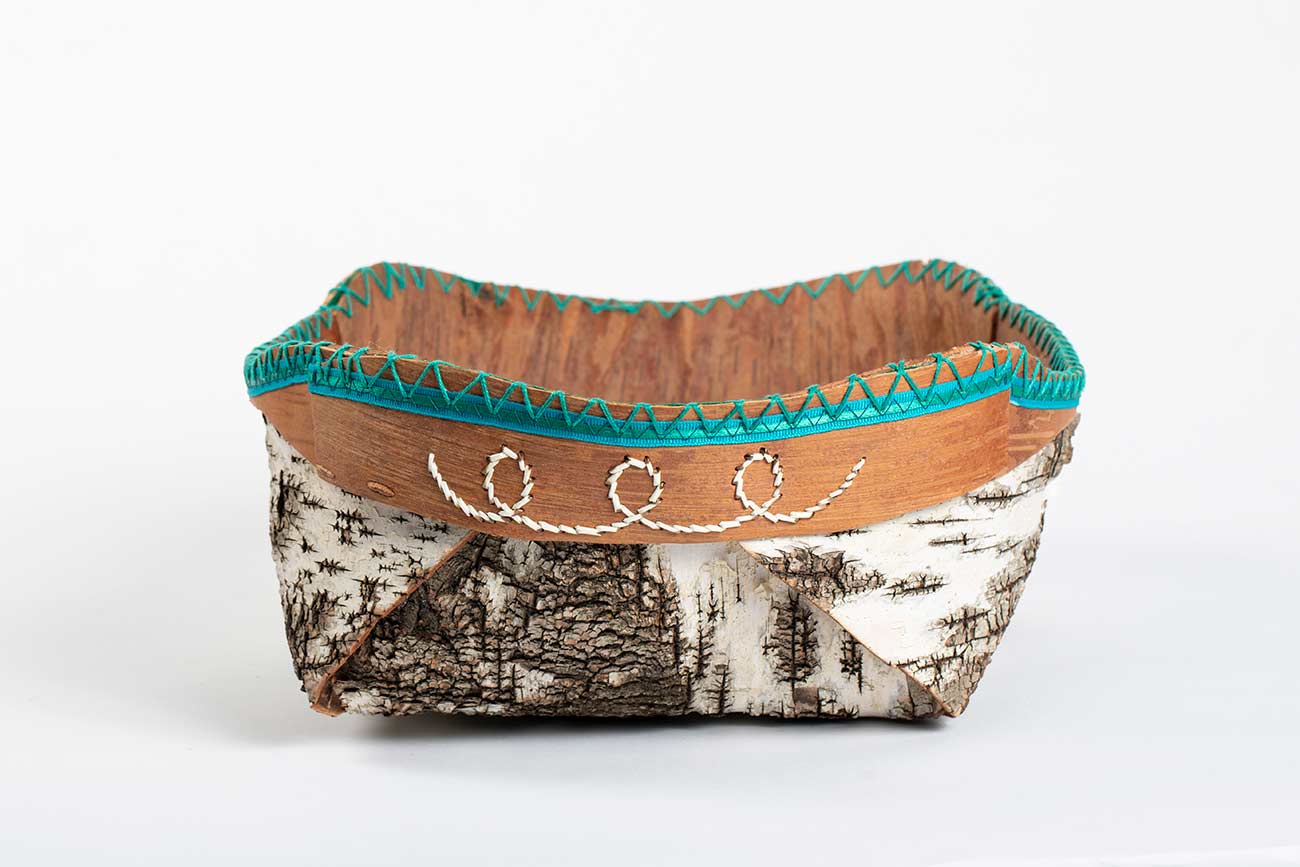
The show’s name, she says, came from a birchbark basket she worked on for nearly two weeks, very early in the morning before sunrise, when “all the birds go nuts.”
“Over that period, I just had all of this information downloaded into me during that early morning time,” she recounts. “All of these things just distilled into two-spirit cultural reclamation, because our two-spirit relatives are missing in our communities, and that’s why we have the issues that we have.”
The resulting basket, with teal criss-crossed cordage lining its edges and white porcupine quills forming spirals on its front, became a physical vessel for Kagigebi to bring two-spirit people back into visibility and celebration. “Queering Indigeneity,” she says, was the perfect name.
Other artists in the show also attest to being spiritually motivated. Giiwedin (St. Croix Chippewa), who uses any pronouns, says they have been aware of their two-spirit identity from a young age, and that has translated into drawing on magic and mysticism in their artwork.
“Two-spirit people are closest to the spiritual mix of both (masculine and feminine), we actually don’t see one side or another,” Giiwedin explains. “We’re almost the pure embodiment of spirit. We were and are the healers. There’s a certain kind of magic and medicine to seeing the world in a vastly different way.”
Giiwedin’s body of work in “Queering Indigeneity” includes drawings of Ojibwe spiritual beings made only with ballpoint pen and paper, a testament to the only materials she had growing up in poverty on the Leech Lake Reservation. Giiwedin says they hope other queer Native kids are inspired and see what they can do with what they have.
Also on view is a compilation of reels Giiwedin has posted to Instagram (@giiwedinindizhinikaaz) as a way to educate about Indigenous and two-spirit culture through a modern form of storytelling. In the exhibit, he explains the origins of the word “two-spirit” and Ojibwe words for gender, as well as demonstrating a jingle dress dance.
“The showing and telling of histories and explaining gives people an understanding of people like me and of the diversity of the people in the exhibit, and that’s what I try to emphasize,” they say. “That’s what I hope to accomplish with the Reels.”
Living history
The presence of two-spirit elders Nick Metcalf (Sicangu Oyate, Rosebud Sioux) and Sharon Day (Bois Forte Ojibwe) in “Queering Indigeneity” points to the undeniable impact of two-spirit people throughout history and speaks to the blessing it is to witness their artwork.
Metcalf, who uses they/them pronouns, was one of four founders of Minnesota Men of Color (MMC), a nonprofit that served queer men of color, women of color and gender-non-conforming people of color between 1998 and 2003. Day created the Minnesota American Indian AIDS Task Force and is now the executive director of its current iteration, the Indigenous Peoples Task Force.
“We are, we were and we do everything,” says Day, who states she prefers the term Indigiqueer for herself.
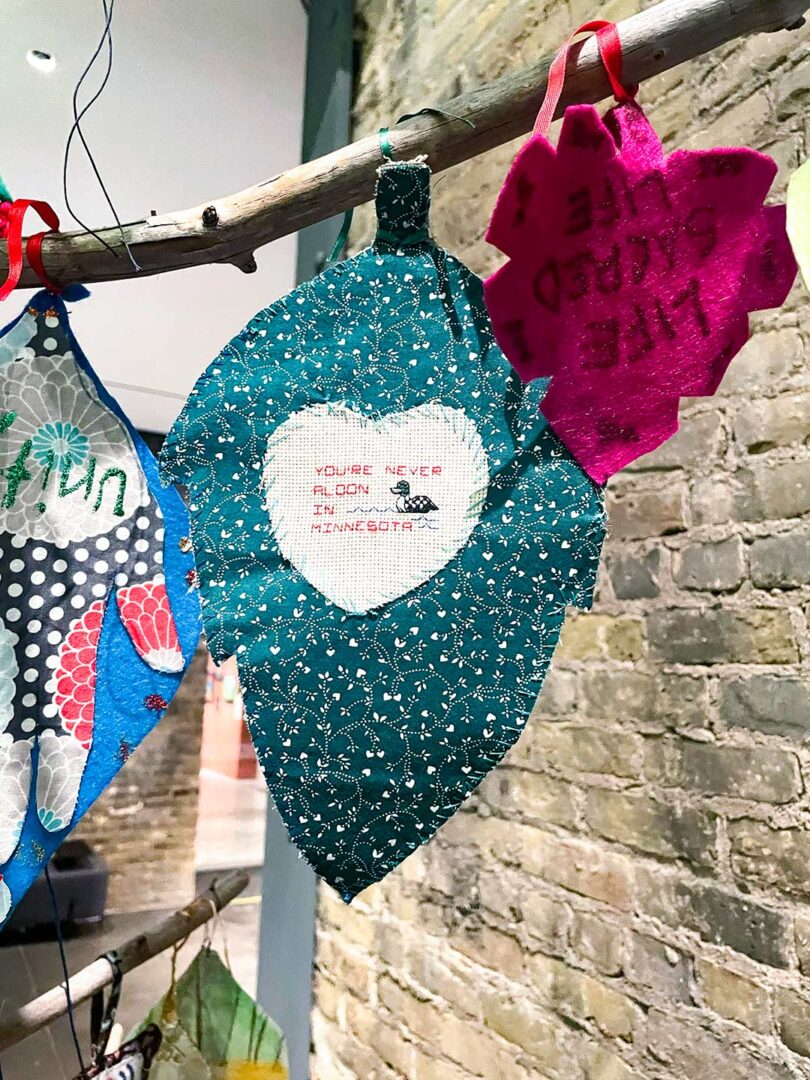
Day’s artwork is emblematic of the community she has spent decades working to uphold. “Tree of Peace” is a 12-foot-tall sculpture made of driftwood from Lake Superior (Gitchi Gami, in the Ojibwe language), adorned with textile leaves created by her friends. Created in the tumultuous year of 2020, it’s a testament to enduring connection in spite of difference.
The figure in Day’s mosaic, “Animikee is Dancing!” she says, is “clearly a dyke!”
“We think of these spiritual guides, they’re always male. This one I wanted to clearly depict as feminine energy being shared with the person standing below,” Day explains. “That was a very personal piece, but it’s an important image for those who never see ourselves in art.”
“A better place for everyone”
All told, Kagigebi says the focus “Queering Indigeneity” puts on two-spirit and Native queer people is “A focus that’s not meant to alienate.” That is, all are welcome to observe, learn from and connect with the exhibition, regardless of how they identify.
When asked what being Indigiqueer means to her, Day says, “It makes me want to make the world a better place for everyone.”




5200 Willson Road, Suite 316 • Edina, MN 55424
©2026 Lavender Media, Inc.
PICKUP AT ONE OF OUR DISTRIBUTION SITES IS LIMITED TO ONE COPY PER PERSON